Understanding Cellular Respiration and Energy Storage in Cells
Learn how cells save energy through storing carbohydrates produced by photosynthesis and how they release and use this energy through cellular respiration. Explore the stages of respiration and fermentation processes, including the respiration equation and the benefits of these energy-producing mechanisms.

Understanding Cellular Respiration and Energy Storage in Cells
E N D
Presentation Transcript
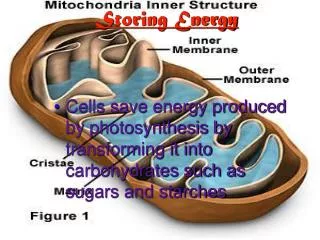
Storing Energy • Cells save energy produced by photosynthesis by transforming it into carbohydrates such as sugars and starches
Cellular Respiration When cells need energy, they get it by breaking down these carbohydrates, releasing and using that stored energy. Because all living things need energy continuously, cells carry out respiration continuously. This process uses oxygen.
During respiration, cells break down simple food molecules like glucose and release energy • The Respiration Equation: • C6H12O6 + 6 O2 >>> 6 CO2 + 6 H2O + energy • (glucose)(oxy.)(carb. Diox.) (water)
2 Stages of Respiration • Stage 1:takes place in the cytoplasm where glucose molecules are broken down into smaller molecules.
Stage 2: • Occurs in the mitochondria • There a chemical reaction using oxygen breaks down these molecules into even smaller molecules, producingenergy. • This also produces CO2 & H20
Fermentation • Provides energy for cells without using oxygen • It produces less energy than respiration • Alcohol fermentation occurs in yeast • Lactic acidfermentation takes place inmuscles.