Overview of Animal Cell Structure and Functions in the Liver
This article explores the intricate structure of animal cells, focusing on liver cells, which play a crucial role in metabolism. Key components include the nucleus, which houses DNA and regulates gene expression through nuclear pores. The endoplasmic reticulum (ER) is examined, detailing its role in protein synthesis, detoxification, and steroid synthesis. Mitochondria, known as the powerhouses of the cell, convert glucose into ATP, while the Golgi apparatus modifies and exports proteins. Additionally, lysosomes and the cytoskeleton are discussed in relation to cellular digestion and structural integrity.

Overview of Animal Cell Structure and Functions in the Liver
E N D
Presentation Transcript
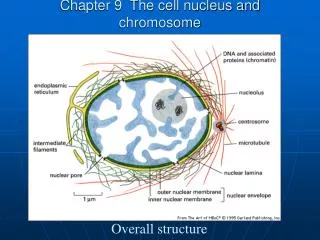
FUNCTIONS OF NUCLEUS: • Nuclear membrane/envelope bilayer, separates and contains nuclear contents (DNA). • Nuclear pores: allow mRNA out of nucleus, nucleotides, nutrients & enzymes in. They are made from protein. • Chromatin: Protein & DNA; form chromosomes when cell divides. • Nucleolus:contains rRNA and Ribosomal proteins.
Rough E.R. Studded with ribosomes Site of protein synthesis for proteins meant for export Phospholipids made here Smooth E.R. Detoxifies poisons (found in liver cells) Synthesize steroids The Endoplasmic Reticulum: ER
Function of Ribosomes • Made from two protein subunits and rRNA • Some are free, found alone in cytoplasm • Others are attached to the RER • Translation of mRNA into polypeptides or PROTEIN SYNTHESIS!
Function of Mitochondria: • Cellular Respiration converts energy in Glucose to ATP • C6H12O6 + O2 CO2 + H2O + 38 ATP • Found in large numbers in energetic cells (sperm cells, muscles etc.)
Golgi apparatus Looks like a series of flattened sacules. Appears close to the cell membrane.
Golgi • Packages, modifies and stores molecules. • Forms transport or secretory vesicles • Involved in export of proteins through exocytosis. • Draw diagram page 2 in green book
Lysosomes: • Contain hydrolytic enzymes (help to perform hydrolysis) for digesting molecules. • These special vacuoles merge with another molecule containing vacuole for cell digestion. • Called “suicide sacs”, contents could destroy cell!
Cytoskeleton • Many protein filaments (actin filaments and microtubules) help organize and anchor cell parts.
Function of cilia and flagella: • Cilia: • Line the respiratory passages and sweep mucus upwards. • Line the oviducts to transport ovum to uterus • Flagella: Propel sperm • towards the ovum.