Exploring Causal Ordering Violations in Agreement Protocols for Synchronous and Asynchronous Systems
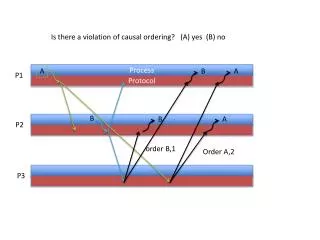
This document analyzes whether causal ordering is violated in processes A and B within two specific protocols. It presents a comprehensive overview of agreement protocols, detailing their capacity to withstand process failures in both synchronous and asynchronous systems. The analysis highlights various scenarios, addressing the tolerances for failed processes across these protocols. By dissecting the underlying mechanics, it aims to clarify the implications of causal ordering in distributed computing environments.

Exploring Causal Ordering Violations in Agreement Protocols for Synchronous and Asynchronous Systems
E N D
Presentation Transcript
Is there a violation of causal ordering? (A) yes (B) no Process A B A P1 Protocol B B A P2 order B,1 Order A,2 P3
Is there a violation of causal ordering? (A) yes (B) no Process A B A B P1 Protocol B A P2 order B,1 Order A,2 P3
Agreement • In synchronous systems, an agreement protocol with n rounds can tolerate: • (A) 0 failed processes • (B) 1 failed process • (C) n-1 failed processes • (D) n failed processes • (E) n+1 failed processes
Agreement • In asynchronous systems, an agreement protocol with n rounds can tolerate: • (A) 0 failed processes • (B) 1 failed process • (C) n-1 failed processes • (D) n failed processes • (E) n+1 failed processes