Understanding Logical, Increment, and Relational Operators in Java
This tutorial explores key concepts of logical, increment, and relational operators in Java. It demonstrates how to use increment (++) and decrement (--) operators, along with relational operators that compare values, resulting in boolean outcomes. Additionally, it highlights logical operators like AND (&&) and OR (||), illustrating short-circuit behavior. Example codes are included for clear understanding, showcasing practical usage and results of these operators in various scenarios. Elevate your Java programming skills with this concise guide.

Understanding Logical, Increment, and Relational Operators in Java
E N D
Presentation Transcript
Shorthand Operator public class Example { public static void main(String[] args) { int j, p, q, r, s, t; j = 5; p = 1; q = 2; r = 3; s = 4; t = 5; p += j; q -= j; r *= j; s /= j; t %= j; System.out.println("p = " + p); System.out.println("q = " + q); System.out.println("r = " + r); System.out.println("s = " + s); System.out.println("t = " + t); } } > java Example p = 6 q = -3 r = 15 s = 0 t = 0 >
Increment/ Decrement Operators • Two unary operators: 1) ++ increments its operand by 1 2) -- decrements its operand by 1 • The operand must be a numerical variable. • Each operation can appear in two versions: • prefix version evaluates the value of the operand after performing the increment/decrement operation • postfix version evaluates the value of the operand before performing the increment/decrement operation
Increment and Decrement public class Example { public static void main(String[] args) { int j, p, q, r, s; j = 5; p = ++j; // j = j + 1; p = j; System.out.println("p = " + p); q = j++; // q = j; j = j + 1; System.out.println("q = " + q); System.out.println("j = " + j); r = --j; // j = j -1; r = j; System.out.println("r = " + r); s = j--; // s = j; j = j - 1; System.out.println("s = " + s); } } > java example p = 6 q = 6 j = 7 r = 6 s = 6 >
Relational Operator • Relational operators determine the relationship that one operand has to the other operand, specifically equality and ordering. • The outcome is always a value of type boolean. • They are most often used in branching and loop control statements.
Relational Operator Examples public class Example { public static void main(String[] args) { int p =2; int q = 2; int r = 3; Integer i = new Integer(10); Integer j = new Integer(10); System.out.println("p < r " + (p < r)); System.out.println("p > r " + (p > r)); System.out.println("p == q " + (p == q)); System.out.println("p != q " + (p != q)); System.out.println("i == j " + (i == j)); System.out.println("i != j " + (i != j)); } } > java Example p < r true p > r false p == q true p != q false i == j false i != j true >
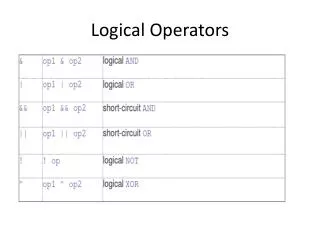
Logical Operators • Logical operators act upon boolean operands only. • The outcome is always a value of type boolean. • In particular, 1and2 and 1or2 logical operators occur in two forms: 1) full op1 & op2 and op1 | op2 where both op1 and op2 are evaluated 2) short-circuit - op1 && op2 and op1 || op2 where op2 is only evaluated if the value of op1 is insufficient to determine the final outcome
Logical (&&) Operator Examples public class Example { public static void main(String[] args) { boolean t = true; boolean f = false; System.out.println("f && f " + (f && f)); System.out.println("f && t " + (f && t)); System.out.println("t && f " + (t && f)); System.out.println("t && t " + (t && t)); } } > java Example f && f false f && t false t && f false t && t true >
Logical (||) Operator Examples public class Example { public static void main(String[] args) { boolean t = true; boolean f = false; System.out.println("f || f " + (f || f)); System.out.println("f || t " + (f || t)); System.out.println("t || f " + (t || f)); System.out.println("t || t " + (t || t)); } } > java Example f || f false f || t true t || f true t || t true >
Logical (!) Operator Examples public class Example { public static void main(String[] args) { boolean t = true; boolean f = false; System.out.println("!f " + !f); System.out.println("!t " + !t); } } > java Example !f true !t false >
Logical Operator ExamplesShort Circuiting with && public class Example { public static void main(String[] args) { boolean b; int j, k; j = 0; k = 0; b = ( j++ == k ) && ( j == ++k ); System.out.println("b, j, k " + b + ", " + j + ", " + k); j = 0; k = 0; b = ( j++ != k ) && ( j == ++k ); System.out.println("b, j, k " + b + ", " + j + ", " + k); } } > java Example b, j, k true 1, 1 > java Example b, j, k true 1, 1 b, j, k false 1, 0 >
Logical Operator ExamplesShort Circuiting with || public class Example { public static void main(String[] args) { boolean b; int j, k; j = 0; k = 0; b = ( j++ == k ) || ( j == ++k ); System.out.println("b, j, k " + b + ", " + j + ", " + k); j = 0; k = 0; b = ( j++ != k ) || ( j == ++k ); System.out.println("b, j, k " + b + ", " + j + ", " + k); } } > java Example b, j, k true 1, 0 > java Example b, j, k true 1, 0 b, j, k true 1, 1 >
Bitwise Operators • Bitwise operators apply to integer types only. • They act on individual bits of their operands. • There are three kinds of bitwise operators: 1) basic bitwise AND, OR, NOT and XOR 2) shifts left, right and right-zero-fill 3) assignments bitwise assignment for all basic and shift operators
Twos Complement Numbers Base 10 A byte of binary +127 01111111 +4 00000100 +3 00000011 +2 00000010 +1 00000001 +0 00000000 -1 11111111 -2 11111110 -3 11111101 -4 11111100 -128 10000000
Adding Twos Complements Base 10Binary +3 00000011 -2 11111110 +1 00000001 Base 10Binary +2 00000010 -3 11111101 -1 11111111
Logical Operators (Bit Level)& | ^ ~ int a = 10; // 00001010 = 10 int b = 12; // 00001100 = 12 a 00000000000000000000000000001010 10 b 00000000000000000000000000001100 12 a & b 00000000000000000000000000001000 8 & AND a 00000000000000000000000000001010 10 b 00000000000000000000000000001100 12 a | b 00000000000000000000000000001110 14 | OR a 00000000000000000000000000001010 10 b 00000000000000000000000000001100 12 a ^ b 00000000000000000000000000000110 6 ^ XOR ~ NOT a 00000000000000000000000000001010 10 ~a 11111111111111111111111111110101 -11
Logical (bit) Operator Examples public class Example { public static void main(String[] args) { int a = 10; // 00001010 = 10 int b = 12; // 00001100 = 12 int and, or, xor, na; and = a & b; // 00001000 = 8 or = a | b; // 00001110 = 14 xor = a ^ b; // 00000110 = 6 na = ~a; // 11110101 = -11 System.out.println("and " + and); System.out.println("or " + or); System.out.println("xor " + xor); System.out.println("na " + na); } } > java Example and 8 or 14 xor 6 na -11 >
Shift Operators (Bit Level)<< >> >>> • Shift Left << Fill with Zeros • Shift Right >> Based on Sign • Shift Right >>> Fill with Zeros
Shift Operators << >> int a = 3; // ...00000011 = 3 int b = -4; // ...11111100 = -4 a 00000000000000000000000000000011 3 a << 2 00000000000000000000000000001100 12 b 11111111111111111111111111111100 -4 b << 2 11111111111111111111111111110000 -16 << Left a 00000000000000000000000000000011 3 a >> 2 00000000000000000000000000000000 0 b 11111111111111111111111111111100 -4 b >> 2 11111111111111111111111111111111 -1 >> Right
Shift Operator >>> int a = 3; // ...00000011 = 3 int b = -4; // ...11111100 = -4 a 00000000000000000000000000000011 3 a >>> 2 00000000000000000000000000000000 0 b 11111111111111111111111111111100 -4 b >>> 2 00111111111111111111111111111111 +big >>> Right 0
Shift Operator Examples public class Example { public static void main(String[] args) { int a = 3; // ...00000011 = 3 int b = -4; // ...11111100 = -4 System.out.println("a<<2 = " + (a<<2)); System.out.println("b<<2 = " + (b<<2)); System.out.println("a>>2 = " + (a>>2)); System.out.println("b>>2 = " + (b>>2)); System.out.println("a>>>2 = " + (a>>>2)); System.out.println("b>>>2 = " + (b>>>2)); } } > java Example a<<2 = 12 b<<2 = -16 a>>2 = 0 b>>2 = -1 a>>>2 = 0 b>>>2 = 1073741823 >
Shift Operator >>> and Automatic Arithmetic Promotion byte a = 3; // 00000011 = 3 byte b = -4; // 11111100 = -4 byte c; c = (byte) a >>> 2 c = (byte) b >>> 2 a 00000011 3 a >>> 2 00000000000000000000000000000000 0 c = (byte) 00000000 0 b 11111100 -4 b >>> 2 00111111111111111111111111111111 1073741823 c = (byte) Much to big for byte 11111111 -1 >>> Right Fill 0
Conditional Operators • General form: expr1? expr2 : expr3 where: 1) expr1 is of type boolean 2) expr2 and expr3 are of the same type If expr1 is true, expr2 is evaluated, otherwise expr3 is evaluated.
Operator Precedence • Java operators are assigned precedence order. • Precedence determines that the expression 1 + 2 * 6 / 3 > 4 && 1 < 0 • if equivalent to (((1 + ((2 * 6) / 3)) > 4) && (1 < 0)) • When operators have the same precedence, the earlier one binds stronger.
Class Participation 1) What would be the result of running the following program: Class test {public static void main(String abc[]) { byte x=256; System.out.println(x); } } a) 256 b) Compilation Error c) Run Time Error
Class Participation • Given a byte value of 01110111, which of the following statements will produce 00111011? (Note: 01110111= 0x77) A. 0x77<<1; B. 0x77>>>1; C. 0x77>>1; D. B and C E. None of the above