Download

1 / 5
50 likes | 195 Vues
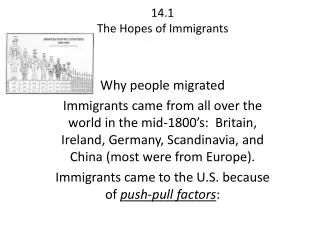
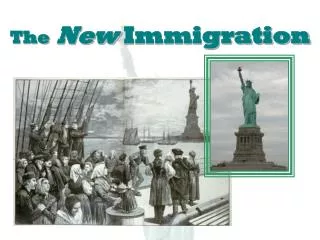
Between 1880 and 1924, over 15 million immigrants from diverse backgrounds such as Austro-Hungarian, Turkish, Lithuanian, Russian, Greek, and Italian, transformed the American landscape. Driven by the promise of jobs during the Industrial Revolution and escaping challenges in Europe, many moved to find a better life. With a mixture of faiths including Jewish and Catholic, these individuals brought a rich tapestry of languages and cultures. Their stories reflect resilience, driven by the demand for unskilled labor, and a desire to escape dire conditions in their homeland.

E N D
“New Immigrants” Now with more immigranty flavor crystals!
“New Immigrants” • ≈ 1880 – 1924 • Over 15 million people immigrated to the US during this time, many of whom were… • Austro-Hungarian, Turkish, Lithuanian, Russian, Greek, Italian, Romania, etc. • Many were Jewish, Catholic or non-religious. • Tons of different languages
Why come to America? • No cats! • Streets are paved with cheese! • Jobs • Industrial Revolution • Unskilled workers were needed to work in factories
Why leave Europe? • Evil cats! • Cheese shortages! • Four major factors (all related to the Industrial Revolution): • Dramatic population increase • Spread of commercial agriculture • Rise of the factory system • Proliferation of inexpensive means of transportation such as steamships and railroads