Comprehensive Review of Cellular Respiration: Key Processes and Mechanisms
This review covers essential aspects of cellular respiration, including its three primary stages: Glycolysis, Krebs Cycle, and Electron Transport Chain. Understand how food molecules are broken down to release energy for cellular functions, and explore the differences between aerobic and anaerobic processes. Learn about the role of NAD+ as an electron carrier, the net production of ATP from glycolysis, and the outcomes of lactic acid and alcoholic fermentation. A thorough grasp of these concepts is crucial for the upcoming test on Wednesday.


Comprehensive Review of Cellular Respiration: Key Processes and Mechanisms
E N D
Presentation Transcript
Notes • You may use your notes on the test. • Whether or not you use them you will turn them in with your test on Wed.
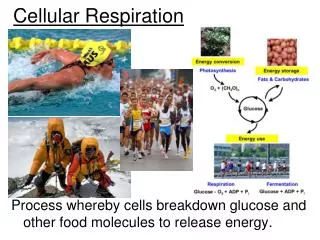
Cellular resp. releases energy by… • A. Breaking down food molecules • B. Breaking down ATP • C. Breaking down CO2 • Answer is: • Food molecules are broken down to provide your cells with energy.
Know the 3 parts of Cellular Respiration(The precursor & its 2 stages)
The 3 parts are… First comes… Glycolysis Second… Krebs Cycle Third… Electron Transport Chain
Krebs Cycle • Starts with pyruvate • Produces NAD+ (p. 210)
Know: e- transport chain • Occurs where? • Mitochondria, (in the inner membrane.)
Where does Glycolysis occur? *In the Cytoplasm What does it begin with? *Glucose
Know the equation for cellular respiration. C6H12O6 + 6O2 Energy + 6H2O + 6CO2 (Balanced)
What kind of cells does Lactic Acid Fermentation mainly occur in? Muscle cells
During Lactic Acid Ferm. • NAD+ is recycled so that ______GLYCOLYSIS____ can continue. • Hint: This produces 2 ATPs.
CO2Ethanol Used to make beer, wine, alcoholic beverages.
How many ATPs are formed from glycolysis + cellular respiration?
In Cellular Respiration • 1 Molecule of glucose yields how many ATPs? 36 This is glycolysis + cellular resp.
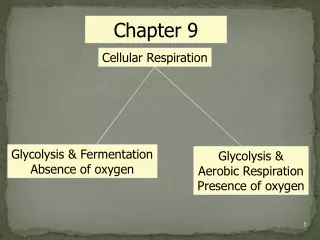
*AEROBIC means: Uses OXYGEN *ANAEROBIC means: Uses NO OXYGEN
Cellular Respiration uses • Oxygen • Cells that don’t use oxygen / don’t go through c.r. , are anaerobic bacteria • Can cause food poisoning