
SlideServe
Menu
Préférences
© SlideServe · v2026

Understanding Immunity: First-Line Defenses to Specific Pathogens

phoebe avatar
12 diapositives · 241 Views · Aug 01, 2014

Learn about immune system defenses against disease-causing organisms, from skin barriers to specific antibody responses. Explore active and passive immunity, vaccines, and the role of T and B cells in fighting pathogens.
Understanding Immunity: First-Line Defenses to Specific Pathogens - slide 1
01 / 12Understanding Immunity: First-Line Defenses to Specific Pathogens
1 / 17

Télécharger la présentation

Understanding Immunity: First-Line Defenses to Specific Pathogens
Une image / un lien ci-dessous est fourni (tel quel) pour télécharger la présentation

Politique de téléchargement : le contenu du site vous est fourni TEL QUEL pour votre information et votre usage personnel ; il ne peut être vendu, concédé sous licence ni partagé sur d’autres sites sans l’accord de son auteur.Le contenu vous est fourni TEL QUEL, pour votre information et votre usage personnel uniquement. Téléchargez la présentation en cliquant sur ce lien. Lors du téléchargement, si vous ne parvenez pas à télécharger une présentation, l’éditeur a peut-être supprimé le fichier de son serveur.Pendant le téléchargement, si vous ne parvenez pas à obtenir une présentation, le fichier a peut-être été supprimé par l’éditeur.

F I N

Plus de contenu associé

Transcription de la présentation
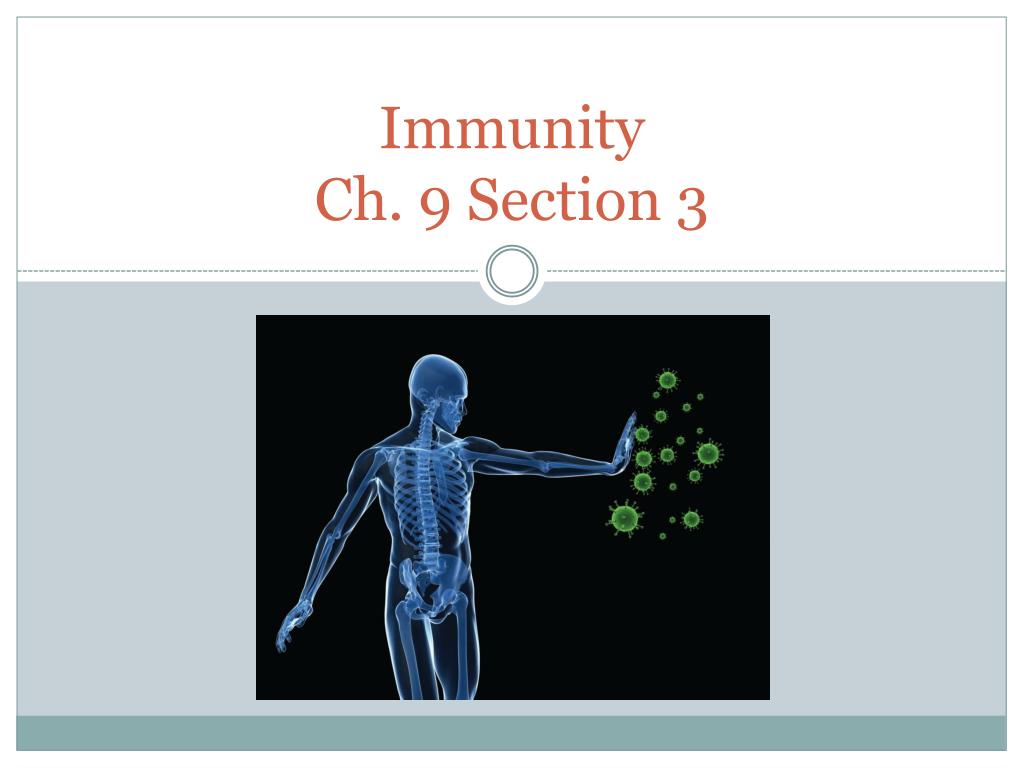
  1. ImmunityCh. 9 Section 3

  2. Immunity 1. pathogens • disease- causing organism • fought by first-line defenses 2. Immune system • second-line of defenses- fights pathogens if they get inside the body • works against specific pathogens

  3. Immunity 3. First-Line Defenses • keep pathogens out • skin, respiratory, digestive, and circulatory system 4. skin • acts like a barrier • perspiration slows the growth of some pathogens

  4. Immunity 5. Respiratory System • internal first-line defense • cilia and mucus trap pathogens • mucus can weaken pathogens’ cell walls • when you cough or sneeze, you get rid of trapped pathogens

  5. Immunity • uses saliva, enzymes, hydrochloric acid and mucus to attack pathogens • saliva can kill bacteria • enzymes in the stomach, pancreas, and liver destroy pathogens • mucus prevents bacteria from sticking to the lining of organs 6. Digestive System

  6. Immunity • when tissue is damaged or infected, chemicals are released to expand capillary walls • this allows more blood to flow to the area with more white blood cells to fight off pathogens 7. inflammation

  7. Immunity • complex molecule that doesn’t belong in your body 8. antigen

  8. Immunity • when immune system finds foreign molecules it calls T cells to help • T cells stimulate B cells to form antibodies • antibody attaches to antigen and makes it useless 9. Specific Immunity

  9. Immunity • release enzymes that help destroy invading matter 10. Killer T cells 11. Helper T cells • turn on the immune system

  10. Immunity • a protein made in response to a specific antigen 12. antibody 13. Memory B cells • have antibodies for specific pathogens • remain in blood, ready to defend against and invasion by the same pathogen if it comes back

  11. Immunity • your body makes its own antibodies in response to an antigen 14. Active Immunity 15. Passive Immunity • when antibodies that have been produced in another animal are put into your body • doesn’t last as long as active immunity so you have to get booster shots

  12. Immunity • a form of the antigen that gives you active immunity against a disease 16. vaccine