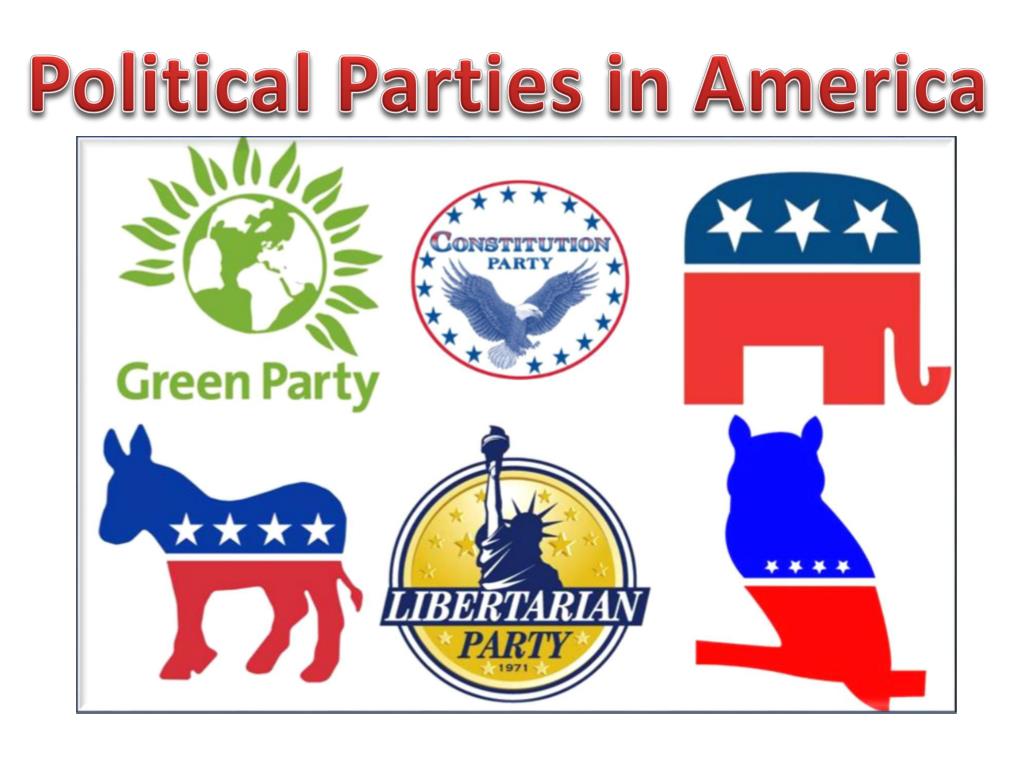
Political Parties in America . Parties and what t hey do?. What is a Party?. Political party: a group of persons who seek to control the government through the winning of elections and holding of public office. Major Parties in America. Democrats Republicans. More Specific….
Une image / un lien ci-dessous est fourni (tel quel) pour télécharger la présentation
Politique de téléchargement : le contenu du site vous est fourni TEL QUEL pour votre information et votre usage personnel ; il ne peut être vendu, concédé sous licence ni partagé sur d’autres sites sans l’accord de son auteur.Le contenu vous est fourni TEL QUEL, pour votre information et votre usage personnel uniquement.Téléchargez la présentation en cliquant sur ce lien.Lors du téléchargement, si vous ne parvenez pas à télécharger une présentation, l’éditeur a peut-être supprimé le fichier de son serveur.Pendant le téléchargement, si vous ne parvenez pas à obtenir une présentation, le fichier a peut-être été supprimé par l’éditeur.
What is a Party? • Political party: • a group of persons who seek to control the government through the winning of elections and holding of public office.
More Specific… • Another more specific definition is a political party is a group of persons who want to control government for what purpose? • To affect certain public policies and programs • The (2) major parties in the US do not fit this definition; they are more election oriented.
Role of Parties • It is clear from American history that political parties are essential to democratic government. • They are the medium through which options are presented to the people.
Role of Parties • Parties are a link between people and their government. • How do they work to ‘blunt’ conflict? • Try to bring conflicting groups together and encourage compromise.
Nominating Candidates • The major function of a political party is to nominate (or name) candidates for public office. • Once a candidate is nominated, what then is the party’s function? • WIN THE ELECTION !!
Informing/Activating Supporters • Big job for political parties is to inform the people. • What are (3) examples of this? • Campaign for candidates • Take stance on issues • Criticize candidates and positions of opponents.
Informing/Activating Supporters • Parties conduct this ‘educational’ process: • through pamphlets, signs, buttons and stickers • with advertisements • in speeches and rallies.
Bonding Agent • In business, a bond is an agreement that protects a person or company against loss caused by a third party. • EXPLAIN the ‘bonding agent’ function in politics: • Parties ensure the good performance of its candidates and officeholders.
Bonding Agent • The party also prompts it’s successful candidates to perform well in office. • What happens if the party fails with this? • Party and its candidates may suffer consequences in future elections.
Governing • Congress and the State legislatures are organized on party lines and they conduct much of their business on the basis of partisanship.
Partisanship • Definition: • Strong support of a political party and their policies.
Governing • In the complicated separation of powers agreement, the executive and legislative branches must cooperate with one another if anything is to get accomplished. • Political parties can help the two branches work together.
Watchdog • Parties act as ‘watchdogs’ over the conduct of the people’s business. • When is this particularly true? • When a party is out of power (does not control the executive branch)
Watchdog • In American politics the party in power is the party that controls the executive branch of government (President/national; Governor/state) • Party out of power plays the role of ‘loyal opposition’.
Loyal Opposition • Definition: • Opposed to the party in power but loyal to the people and the nation.
Two-Party System • A minor party is one of the many political parties without wide voter support. • DESCRIBE the two-party in American politics. • Democrats and Republicans are only party that has reasonable chance of winning public office in US.
Why a Two-Party System? • A number of factors help to explain why America has had and continues to have a two-party system. • There are four major reasons that can explain this:
The Historical Basis • The Framers of the Constitution were opposed to political parties.
Origin of Two-Party System • Argument over the ratification of the new Constitution. • Federalists • Anti-Federalists • Democratic-Republicans
The Force of Tradition • Once established, human institutions are likely to be self-perpetuating. • Why do most Americans accept the idea of a two-party system? • Because there has always been this system!
The Electoral System • Several features of the American electoral system to tend to promote the existence of the two major parties:
Single Member District • Single member districts: • contests in which only one candidate is elected to each office on the ballot.
Plurality • Definition: • The largest number of votes for an office. • NOTE: a plurality need not be a majority (which is more than half of all votes cast)
The Electoral System • Much of American election law is purposely written to discourage non-major party candidates • Republicans and Democrats work in a bipartisan(work together) way.
Bi-partisanship • Definition: • When both major political parties work together on an issue.
The Electoral System • How do they major parties make it difficult for the smaller ones? • Election laws are shaped to frustrate the minor parties. • Can’t get on ballot or take part in debates.
Ideological Consensus • Over time, the American people have shared many of the same ideas, the same basic principles, and the same patterns of belief. • Americans are not alike; the US is a pluralistic society:one consisting of several distinct cultures and groups.
Ideological Consensus • Americans come to a consensus(a general agreement among various groups) on fundamental matters, but the nation has been divided at times • How has this ideological consensus made the 2 major parties look alike? • Both parties tend to be moderate and try to occupy “the middle of the road” to get more voters.
Multi-Party Systems • A system in which several major and many lesser parties exist, seriously compete for, and actually win, public offices – European democracies. • What are the parties in this system based on? • A particular interest.
Multi-Party Systems • Weakness here is that one party is often unable to win the support of a majority of the voters. • The result is that that power to govern must be shared by a number of parties in a coalition.
Coalition • DEFINE: • A temporary alliance of several groups who come together to form a working majority and so to control government.
One-Party Systems • The one-party system is really a NO PARTY system. • Usually found in dictatorships today.
One-Party in US ?? • How can parts of the United States be described as ‘one-party’? • In certain parts of the US, only one political party has a real chance to win.
Membership Patterns • Membership in a party is purely voluntary – an individual chooses to be a Democrat, Republican, independent, or join a minor party. • The two major parties are broadly based in order to attract as much support as they can • they try to get a cross-section of America’s population.
Membership Patterns • Individuals identify themselves with a party for many reasons with family as a key-deciding factor. • It is also true that certain segments of the electorate tend to be aligned with one of the major parties – for a time:
Membership Patterns Democrats Republicans • African-Americans • Women • Catholics and Jews • Union Members • Urban areas of country • Protestants • Males • Business community • Rural sections of country
Federalists • Formed around Alexander Hamilton. • Appealed to financial, manufacturing and commercial interests. • Wanted a strong national government and executive. • What was their view of the Constitution? • Liberal (loose) interpretation
Democratic-Republicans • Key leader Thomas Jefferson. • Appealed to shopkeepers, laborers, farmers and planters. • Wanted a limited national government where Congress would have more power. • What was their view of the Constitution? • Strict interpretation