Understanding Natural Selection: Key Concepts and Mechanisms of Evolution
This overview explores the principles of natural selection as introduced by Darwin and Wallace, highlighting the ideas of exponential growth, competition, and variation in populations. Influenced by Malthus, they emphasized that species produce more offspring than the environment can sustain, leading to a struggle for survival. The synthesis of Mendelian genetics and evolutionary theory—termed Neo-Darwinism—provides insight into the mechanisms of inheritance and adaptation. Observations of natural selection in action underscore its role in evolution, though other mechanisms also contribute to species development.

Understanding Natural Selection: Key Concepts and Mechanisms of Evolution
E N D
Presentation Transcript
NATURAL SELECTION The great biological paradigm © 2008 Paul Billiet ODWS
Observation 1: Exponential growth Populations tend to produce more offspring than the environment can support © 2008 Paul Billiet ODWS
Thomas Malthus • Essay on the Principle of Population (1798) • Populations in nature cannot continually increase sooner or later food supply is insufficient and famine stops further growth • Both Charles Darwin and Alfred Russel Wallace had read Malthus and understood the idea of exponential population growth © 2008 Paul Billiet ODWS
Population Growth • 1 pair of cockroaches could produce 164 000 million in 7 months Cockroach population © 2008 Paul Billiet ODWS
Observation 2: Zero growth The numbers of individuals in a population remain stable In terms of population growth the population at its carrying capacity has zero growth © 2008 Paul Billiet ODWS
Numbers Time Population growth K 3 2 1 © 2008 Paul Billiet ODWS
Deduction 1 Competition There must be a struggle for survival Some of the offspring produced in a generation do not survive. Darwin identified competition as a major factor limiting population sizes © 2008 Paul Billiet ODWS
Observation 3: Variation • Some of these variations are inherited by the offspring • The mechanism of the inheritance of genes was being worked out at this time remained undiscovered by biologists until 1900 • Darwin was however aware that sexual reproduction mixes variations to produce new combinations (recombinants) © 2008 Paul Billiet ODWS
Neo-Darwinism • The great synthesis of the 20th century • Mendel’s work was able to explain some of the patterns of inheritance through the mixing that occurs during meiosisand fertilisation • Darwin could not explain the origin of new variants • This had to wait until the 1920s and 1930s when work began on mutationsafter the discovery of radiation © 2008 Paul Billiet ODWS
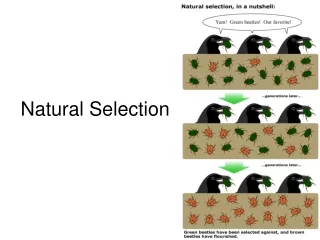
Deduction 2: Survival of the fittest • There will be a struggle for survival between the members of the population • Individuals with advantageous variations will breed and produce more offspring © 2008 Paul Billiet ODWS
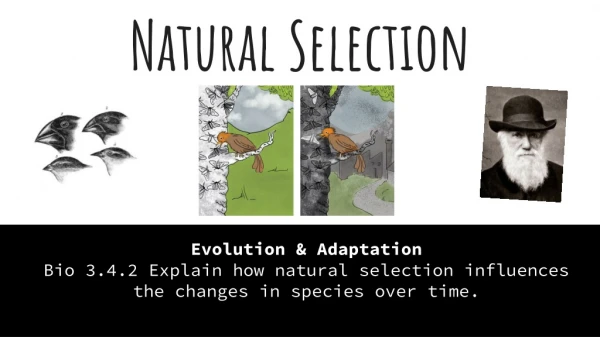
Natural selection in action • As generations pass by, the proportions of the alleles for the different variants will change in favour of those that provide the best adaptations • Natural selection has been observed at work in populations of species over the past century • Examples include: pesticide resistance in insects, antibiotic resistance in bacteria, industrial melanism in moths, tolerance to heavy metals in plants © 2008 Paul Billiet ODWS
The Origin of Species by Natural Selection • Darwin and Wallace argued that if natural selection proceeded for a long enough period of time it could bring about the evolution of new species • Darwin himself favoured a long period of slow changes • Recently this has been refined to include the possibility of rapid changes over a short period of time (punctuated equilibrium) © 2008 Paul Billiet ODWS
Natural selection is not the only way • Whether fast or slow, observing the evolution of a new species is unlikely in the lifetime of a scientist • That species evolve is a fact but that they evolve by natural selection remains a theory • Other mechanisms exist that can also lead to the evolution of species (e.g. genetic drift) © 2008 Paul Billiet ODWS
Thylacine Thylacinus cynocephalus Wolf Canis lupus Convergent Evolution • Species exposed to the same selective pressure in different parts of the world tend to develop the same adaptations • Even though they may be completely unrelated • e.g. the placental wolf and the marsupial thylacine or Tasmanian wolf © 2008 Paul Billiet ODWS
Divergent Evolution • Populations of a species that are separated and evolve under different selective pressures develop different adaptations as they diverge • They are usually geographically separated so that there is a barrier to the mixing of genes © 2008 Paul Billiet ODWS
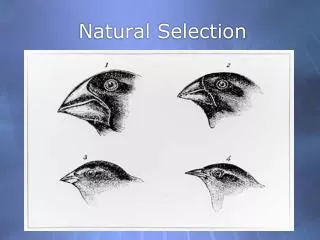
Adaptive radiation Species that populate a new area where there are vacant niches will diverge and specialise as they fill the vacant niches (e.g. Darwin’s Finches on the Galapagos) © 2008 Paul Billiet ODWS