Understanding Immigration Patterns and Assimilation Factors in America
This resource explores the evolution of immigration patterns to the United States, focusing on the sources and reasons behind this migration. It examines the historical context of immigration around 1910 compared to contemporary trends, particularly regarding Asian immigration. The concepts of push and pull factors are discussed, shedding light on why people migrate. Additionally, it delves into the assimilation process across generations, emphasizing how cultural exchanges shape both immigrant communities and American society. The implications of stereotypes on immigration policy are also analyzed.

Understanding Immigration Patterns and Assimilation Factors in America
E N D
Presentation Transcript
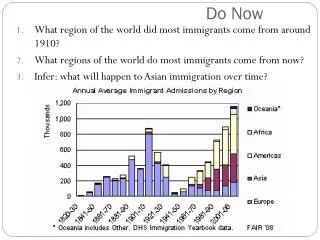
Do Now • What region of the world did most immigrants come from around 1910? • What regions of the world do most immigrants come from now? • Infer: what will happen to Asian immigration over time?
Coming to America Why do people migrate? What are the patterns of assimilation? How do stereotypes drive US immigration policy?
Vocab! • Immigrant • Somebody who moves to another country • Emigrant • Somebody who leaves from a country • Ex. Leaving America • Push factors • Why people leave • Pull factors • Why people come to any given place • Assimilation • Two groups combining • Coffee and sugar!
Push and Pull Factors Activity • Push factor • What makes you LEAVE your country • Pull Factor • Why you CHOOSE one place to move TO
Q1 • Deprivation is poverty • According to this map, what is a major push factor for Mexicans wanting to come to the US? • What region of Mexico is most likely to immigrate?
Assimilation • Cultural process of assimilating one group into another • Usually involves some aspects of culture being adopted, and others being lost • For large immigrant groups, America adopts some of their customs, while others not vs
Assimilation • 1st generation, new immigrant • Keeps most aspects of mother culture • Lives in “ethnic” neighborhood called a ghetto • 2nd generation, first born citizens • In between two worlds • Raised by 1st gen, raised in new country • 3rd generation • Revolts against “old” ways • Strives to be “American” • Moves out of “ethnic” neighborhood (ghetto)
Cartoon Activity • Analyze the following political cartoons with your partner • Be prepared to share with the class: • What group(s) is your cartoon about? • What specifically is showing assimilation (Cite specific evidence: “I see…”) • What is the opinion of the author on immigrants or assimilation? (Do they like immigrants)
Exit Ticket • Explain 3 examples of assimilation in your neighborhood, city, state, or country • Why do younger people assimilate better than older people? Bonus Question: Is assimilation always beneficial to both parties?