Download
1 / 1
20 likes | 159 Vues
This project explores innovative adaptive waveform design methodologies to enhance communication and sensing systems' performance in varying channel conditions. By leveraging recent advancements in information processing and hardware, we aim to exploit waveform characteristics that influence performance. The research includes developing design methods that utilize diversities, modeling the environment for optimal waveform selection, and testing new designs in realistic settings. A key goal is to unify perspectives across both communication and sensing applications, ensuring cross-functional advancements and demonstrating the benefits of waveform scheduling.

E N D
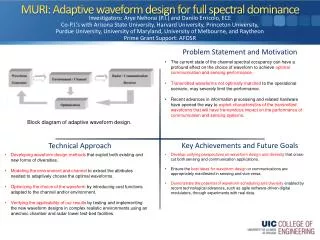
MURI: Adaptive waveform design for full spectral dominance Investigators: AryeNehorai (P.I.) and DaniloErricolo, ECE Co-P.I.’s with Arizona State University, Harvard University, Princeton University, Purdue University, University of Maryland, University of Melbourne, and Raytheon Prime Grant Support: AFOSR • The current state of the channel spectral occupancy can have a profound effect on the choice of waveform to achieve optimal communication and sensing performance. • Transmitted waveforms not optimally matched to the operational scenario, may severely limit the performance. • Recent advances in information processing and related hardware have opened the way to exploit characteristics of the transmitted waveforms that will have tremendous impact on the performance of communication and sensing systems. Block diagram of adaptive waveform design. • Developing waveform design methods that exploit both existing and new forms of diversities. • Modeling the environment and channel to extract the attributes needed to adaptively choose the optimal waveforms. • Optimizing the choice of the waveform by introducing cost functions adapted to the channel and/or environment. • Verifying the applicability of our results by testing and implementing the new waveform designs in complex realistic environments using an anechoic chamber and radar tower test-bed facilities. • Develop unifying perspectives on waveform design and diversity that cross-cut both sensing and communication applications. • Ensure the best ideas for waveform design in communications are appropriately manifested in sensing and vice versa. • Demonstrate the potential of waveform scheduling and diversity enabled by recent technological advances, such as agile software-driven digital modulators, through experiments with real data.




![Building Adaptive Designs Now [UI17]](https://cdn4.slideserve.com/7565374/building-adaptive-designs-now-dt.jpg)