
Mastering Electric Circuits: Basics and Diagrams
E N D
Presentation Transcript
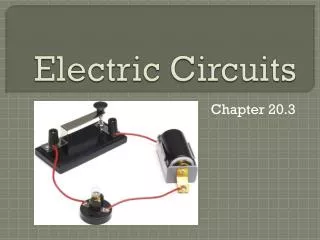
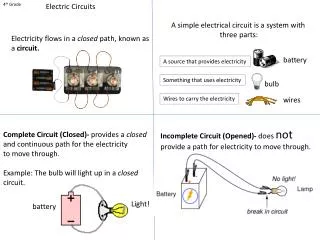
The Basics • Circuit: Any path along which electrons can flow • Electrons will only flow if the circuit is complete with no gaps • Open Circuits are broken and do not allow the flow of electrons • Closed Circuits are complete and allow the flow of electrons
Types of Circuits • Devices within a circuit can be connected in one of two ways: • In Series: Devices form a single pathway for electrons to flow • In Parallel: Devices form branches, each of which is a separate path for the flow of electrons
Series Circuits • All current passing through each device is the same • Ohm’s Law (I = V/R) applies to the entire circuit, AND each individual device within the circuit • Drawback: If one device in the circuit fails, the entire circuit will fail • i.e.) If one light goes out, they all go out
Parallel Circuits • Each device connects the same 2 points in the circuit • Voltage is the same across each branch • The total current in the circuit is the sum of the currents in each branch • More parallel branches = less circuit resistance = MORE CURRENT
Parallel Circuits • Advantage: If one device in the circuit fails, the rest of the circuit still functions • i.e.) If one light goes out, the others stay lit
Connecting Wire • Battery • Resistor • Capacitor • Open Switch • Closed Switch Schematic Diagrams • Simple diagrams which describe electric circuits
Schematic Diagrams - Examples • Two series 3 W resistors in parallel with a 1 mF capacitor, connected to a 12 V battery • Three parallel 2 mF capacitors connected in series to a 10 W resistor and 1.5 V battery • Commonly used symbols
Bell Ringer • Draw the following Schematics • Two series resistors in parallel with a capacitor, connected to a battery • Three parallel capacitors connected in series to a resistor and battery
R1 = 8 W R3 = 8 W R2 = 8 W Equivalent Resistance • Combining resistors in a compound circuit: • Equivalent Resistance: The value of the single resistor that would represent the resistance of all of the devices in a circuit
1 1 1 1 … = + + Req R1 R2 R3 Equivalent Resistance • For series circuits: Req = R1 + R2 + R3 + … • For parallel circuits:
R1 = 8 W R3 = 8 W R2 = 8 W Bell Ringer Calculate the Equivalent Resistance for the circuit below…
Bell Ringer What is the equivalent resistance for the circuit below?
Bell Ringer How much power is dissipated by a 24,000Ω as 120V are sent across it?