Download
1 / 6
60 likes | 211 Vues
This review covers essential characteristics of various unicellular organisms studied in Mrs. Wharton's Science Class. Discover the fascinating world of amoebas, which utilize pseudopods for movement and reproduce via binary fission. Learn about Euglena, a unique organism that can both autotrophically and heterotrophically acquire food, using flagella for motion. Explore paramecium’s distinct movement with cilia and its dual reproductive strategies. Delve into Volvox, known for its photosynthesis capabilities. Understand key organelles that play vital roles in these organisms' functioning.

E N D
Single Celled Organisms Review Mrs. Wharton’s Science Class
Amoebas • Unicellular, Eukaryotic, heterotrophic • Moves-using Psuedopods • Reproduces- Binary fission • Eats-engulfing
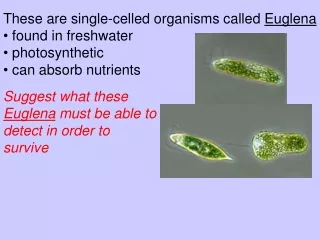
Euglena • Unicellular, eukaryotic, both Heterotrophic and autotrophic • Moves- Flagella • Reproduces- fission (cell splits) • Eats- eyespot senses light to gather for photosynthesis
Paramecium • Unicellular, eukaryotic, heterotrophic • Moves- cilia • Reproduces-sexually and asexually • Eats food from environment- through oral grove, food vacuole, and anal pore.
Volvox • Unicellular, eukaryotic, autotrophic • Moves- flagella • Reproduces- both sexually and asexually • Eats- by using the eye spot to sense light so photosynthesis can occur.
Organelles • Nucleus- Control center “brain” of the cell, contains genetic material (DNA) • Cytoplasm- the jelly like substance that surrounds the organelles within the cell • Contractile Vacuole- Gets rid of water/ wastes within the cell • Food Vacuole- surrounds and digests food within the cell • Chloroplasts- necessary organelle for photosynthesis • Eyespot- senses light • Cell membrane- controls what comes into and out of the cell.