The Impact of the Industrial Revolution on Germany and Italy: Unification and Beyond
The late 1800s marked a pivotal era for both Germany and Italy, as figures like Otto von Bismarck and Giuseppe Garibaldi navigated the unification of their nations amidst the backdrop of the Industrial Revolution. Bismarck’s “blood and iron” strategy emphasized military power and realpolitik, while Garibaldi's grassroots efforts showcased popular sentiment toward unification. This period also saw significant changes in industrialization, societal impacts, and the rise of labor movements, all while nationalistic sentiments surged in response to imperialism.

The Impact of the Industrial Revolution on Germany and Italy: Unification and Beyond
E N D
Presentation Transcript
Germany late 1800s Otto von Bismarck Unification of Germany
Goals Methods • Unification of Germany • Increase Prussian Power • Decrease Austrian Influence in Germany • “Blood and Iron” • War (Franco-Prussian War of 1870) • Trickery • Realpolitik– do whatever is necessary to achieve goals, not what is moral Otto Von Bismarck
Italy late 1800s Giuseppe Garibaldi and Count Cavour Unification of Italy
Industrial Revolution • Started in England • Spread to Europe and the United States • Replaced cottage industries • Textile, iron, and steel industries • Led to increased imperialism in search of raw materials
Factories replaced cottage industries also known as the putting-out system • The putting out system was a way of spinning thread by giving bundles of wool to women who would spin at home
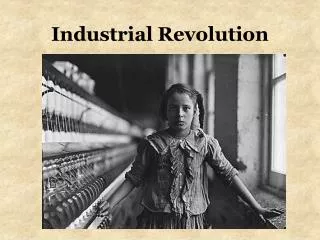
Harsh working conditions with men competing with women and children for wages • Child labor that kept costs of production low and profits high • Owners of mines and factories had control over employees lives The Factory System
Social Effects Labor Unions • Women and children entering the workplace as cheap labor • Introduction of reforms to end child labor • Expansion of education • Women’s demands for suffrage • Encouraged strikes to improve working conditions • Lobbied for laws to improve the lives of workers • Wanted worker rights and collective bargaining between labor and management
Capitalism Socialism • Adam Smith’s Wealth of Nations • Role of market competition and entrepreneurial abilities • Karl Marx’s Communist Manifesto and Das Capital • Response to the injustices of capitalism • Importance of redistribution of wealth
Population Increase • Improved Transportation • Urbanization • Environmental Pollution • Increased Education • Growth of the Middle Class Impacts of the Industrial Revolution
Industrial nations in Europe needed natural resources and markets to expand their economies • These nations competed to control Africa and Asia to secure their economic and political success • Colonies (areas directly ruled by home country) • Protectorates (Egypt/Britain) • Spheres of Influence (China) Imperialism
European domination • European conflicts carried to the colonies • Christian missionary efforts • Spheres of influence in China • Suez Canal • East India Company’s domination of Indian States • American opening of Japan to trade Imperialism in Africa and Asia
Rise of nationalism in colonized countries such as India • Armed rebellions such as Boxer rebellion in China in 1899 - 1901 Response to Imperialism