The Intermediate Disturbance Hypothesis: Maintaining Biodiversity in Dynamic Ecosystems
The Intermediate Disturbance Hypothesis posits that ecosystems experience the highest levels of biodiversity at intermediate disturbance scales. Low disturbance leads to competitive exclusion, reducing diversity, while high disturbance allows only a few specialized colonizers to survive in rapidly changing environments. This concept, explored by Connell (1978) and Grime (1973), highlights the delicate balance within ecosystems, such as tropical rainforests and coral reefs, where diversity thrives in non-equilibrium states.

The Intermediate Disturbance Hypothesis: Maintaining Biodiversity in Dynamic Ecosystems
E N D
Presentation Transcript
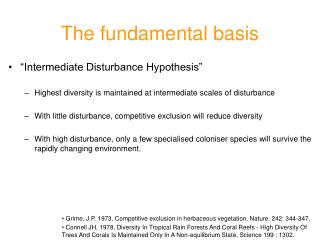
The fundamental basis • “Intermediate Disturbance Hypothesis” • Highest diversity is maintained at intermediate scales of disturbance • With little disturbance, competitive exclusion will reduce diversity • With high disturbance, only a few specialised coloniser species will survive the rapidly changing environment. • Grime, J.P. 1973. Competitive exclusion in herbaceous vegetation. Nature. 242: 344-347. • Connell JH, 1978, Diversity In Tropical Rain Forests And Coral Reefs - High Diversity Of Trees And Corals Is Maintained Only In A Non-equilibrium State, Science 199 : 1302.
The fundamental basis Connell JH, 1978, Diversity In Tropical Rain Forests And Coral Reefs - High Diversity Of Trees And Corals Is Maintained Only In A Non-equilibrium State, Science 199 : 1302.