Understanding Torque: Mechanics of Levers and Static Equilibrium
This guide explores the concept of torque and its application in levers. Torque is defined as the turning effect created by a force on a rigid object around an axis or fulcrum, measured in Newton-metres (Nm). Learn how the distance from the fulcrum impacts the ease of applying force, and calculate effort and load torques for levers in static equilibrium. Examples include determining the effort force needed to lift a load with various lever classes and calculating the maximum mass that can be lifted based on applied force and arm lengths.

Understanding Torque: Mechanics of Levers and Static Equilibrium
E N D
Presentation Transcript
Machines Levers & Torque
Torque • The turning effect caused by a force on a rigid object around an axis or fulcrum. • Represented by T • Units: Newton metres (Nm) • Consider a textbook. Is it easier to open the book by pushing closer to the spine (fulcrum) or further away? • The further away the easier it is.
From this we can conclude that torque depends on two quantities: • The (perpendicular) force applied. • The distance away. • In other words: Where: T = Torque (Nm) F = Force (N) d= Distance (m)
Eg.1: Calculate the magnitude of the torque on a wrench if 100 N of force are applied 0.30m from the bolt.
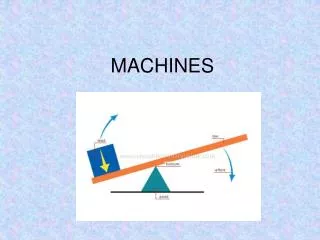
Torque & Levers • Two torques can be calculated for a lever: • Effort Torque (TE ): • Load Torque (TL): • Where: • F = Force (effort / load) • d= Arm length (effort / load)
Static Equilibrium & Levers In order for a lever to be in static equilibrium (not moving) we use the law of levers:
Eg.2: What effort force is required to lift 45 kg using a first class lever with a load arm of 0.4m and an effort arm of 2m? • Eg.3: Supposing you can provide an effort force of 100N, what is the largest mass you can lift with a second class lever and an effort arm length of 1.2m and a load arm length of 0.25m?