Download
1 / 17
170 likes | 284 Vues
Dive into the progressive tense, from forming it with "estar" to using the present participle, with examples and verb changes covered. Understand the difference between the present participle and gerund, along with key irregulars. Practice with pronouns and see how the gerund can function like an adverb. Learn common verbs and nuances, such as continuing actions or gradual processes. Delve into the infinitive versus gerund and see how they function differently. Improve your Spanish skills with real-world examples and exercises.

E N D
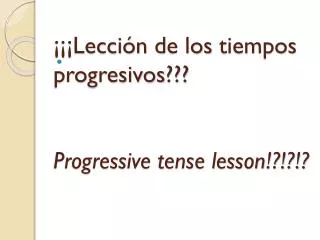
¡¡¡Lección de los tiemposprogresivos???Progressive tense lesson!?!?!?
The progressive tense describes actions in progress • I’m eating? • ¿Estoycomiendo? • He was eating? • ¿Estabacomiendo?
You can use estar in the present, imperfect, preterit, future, condicional, subjunctives • I’m eating. • Estoycomiendo. • I was eating. • Estabacomiendo. • I will be eating. • Estarécomiendo. • I would be eating, if I weren’t sleeping. • Estaríacomiendo, si no estuvieradurmiendo. • It’s good that I’m eating. • Es buenoqueyoestécomiendo.
How do you form this thing? • estar • + • the present participle (-ing word in English)
The present participle / gerund • -arverbs change to: • -ando • -er / irverbs change to: • -iendo • Comer • Comiendo • Trabajar • trabajando
The present participle / gerund • What’s the difference between the present participle and the gerund? • I don’t know; what is this, English class?
The present participle / gerund • (Actually, in English the –ing word is considered a gerund if it functions like a noun [“Swimming is bad”] and it’s a present participle if it works with another verb [“I’m swimming”])
The present participle / gerund:¡-irstem-changing! • -ir stem changing verbs get the same change in the gerund as in the preterit: • morir: muriendo • pedir: pidiendo • seguir: siguiendo • sentir: sintiendo
The present participle / gerund:¡Vowel (or vowel sound) in front of -er / -ir! • caer: cayendo • zambullir: zambullendo • traer: trayendo
The present participle / gerund:¡Irregulars! • decir: diciendo • poder: pudiendo • ir: yendo***** • ***** Don’t ever use this form in your life and you’ll be fine; to say “I am going” say “Voy” etc.
Other verbs with the gerund • continuar / seguir= to continue doing something • andar= to go around doing something • ir= to gradually be doing something • Sigocomiendo. • I keep eating. • Ella andacomiendo. • She goes around eating. • Vamoscomiendomás y más. • We’re gradually eating more and more.
Attach pronouns; accent on the letter before -ndo • comiéndolo • diciéndoselas • masticándola
El infintivo vs. El gerundio Theinfinitive vs. Thegerund!!!!!
When the –ing word in English functions like a noun, you have to use the infinitive in Spanish • Reading is good. • Leer es bueno. • I like reading more than eating. • Me gusta leer más que comer. • After reading, sometimes I read more. • Después de leer, a veces leo más.
The –ing / -ndo form can function like an adverb that describes the main verbal action in both English and in Spanish; in English it’s sometimes Introduced with by • You can learn a lot by reading things. • Puedes aprender mucho leyendo cosas. • He walked home, reading the whole way. • Caminaba a casa, leyendo todo el camino. • She slowly gave way to the soft slumber of dreamland, reading all the while • Ella [etc.], leyendo.
Escribir en español • You won’t win any friends by tricking them. • Surviving is a good option.
You knew this was coming: • What’s Juan doing? • He’s still reading, falling, saying and dying. • I wouldn’t be listening to music if I were sleeping. • Juan was ordering lemonade when he fell down. • Juan is eating it. • We are gradually learning them. • Surviving is a good option.