Innovations in TREDI for CSR: Enhanced Field Regularization and Particle Simulation Techniques
This document presents advancements in the TREDI simulation code for coherent synchrotron radiation (CSR). Key features include efficient handling of retarded potentials, improved field regularization, and optimized CPU usage. The implementation of a macroparticle model has significantly reduced noise effects, while graphical interfaces (Tcl/Tk, Mathematica) facilitate user interaction. Recent improvements decreased computation time for simulations involving thousands of macroparticles. The potential for future enhancements, diagnostics, and noise suppression techniques is explored based on outcomes from the ICFA Beam Dynamics mini-workshop at DESY-Zeuthen.

Innovations in TREDI for CSR: Enhanced Field Regularization and Particle Simulation Techniques
E N D
Presentation Transcript
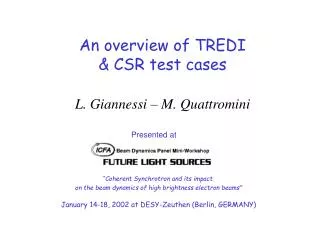
TREDI test forCSR Presented at L. Giannessi – M. Quattromini
Source R(t’) Target TREDI : SELF FIELDS & Retarded Potentials • Trajectories are stored and the fields evaluation requires bracketing of • the retarded condition. • Cpu – memory consuming • Non trivial field reglarization by grid assignement (Parmela mode) • “extended particles” requires careful treatment of ret. condition
TREDI Features • 15000 lines in C language; • Scalar & Parallel (MPI 2.0); • Unix & Windows versions; • Tcl/Tk Gui (pre-processing); • Mathematica & MathCad frontends (post-processing); • Output format in NCSA HDF5 format (solve endian-ness/alignement problems)
Conclusions of Zehuten workshop • The noise suppression method has reduced the effects of SF on longitudinal phase space, without being completely effective in the transverse phase space • A rigorous model of fields regularization, relying on a realistic momentum dispersion of macroparticles will be soon implemented • The low number of macroparticles in severely limiting the reliability of the results • Diagnostic on fields will be implemented to improve insight on the smoothing procedure • The reason of the slow down of the code must be understood • Before the end of the workshop the 1000 particles case will be finished - we will see.
six months after Zehuten, Chia Laguna… • Introduced radiative energy loss (ISR) • Now use HDF5 data format support to fix endianess/alignments problems (output portability to different platforms) • ?? Improved acceleration fields smothness (more work required, no manifestly covariant, CPU consuming) Fields blow up when we have collinear divergencies – Solution: target macro particles are given a finite extension in space • Big speed up (improved retarded time condition routine): • six months ago: very few particles (300 particles 4h on an IBM SP3/16 nodes - 400 MHz each) • Now: 1000 particles 35m on an equivalent platform 10000 particles in 27h on a 32CPUs platform • improvements and bug fixes; recently introduced a “Parmela-like” mode (instantaneous interactions,MUCH faster still experimental)
After changes to field regularization Ex=2.3 mm-mrad Ex=1.8 mm-mrad
ICFA Beam Dynamics mini workshopCoherent Synchrotron Radiation and its impact onthe dynamics of high brightness electron beamsJanuary 14-18, 2002 at DESY-Zeuthen (Berlin, GERMANY)http://www.desy.de/csr * 15% cut of charge to reduce noise
Conclusions • The agreement with other codes is improved with the new macroparticles model • The cpu time is greatly reduced, this allows to run a larger number of macroparticles, but not yet sufficient to simulate microbunching. • Fields regularization requires more work (still time consuming, not covariant) • The code provides reasonable results in a wide range of conditions … start to FEL simulations ?