Innovative Bio-Templated Electronic Materials and Their Societal Impact
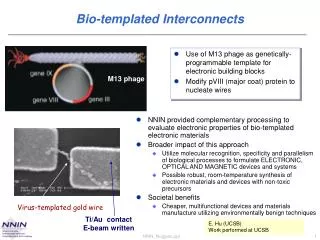
This project explores the use of bio-templated electronic materials, specifically utilizing M13 phage as a programmable template for creating electronic, optical, and magnetic devices. By harnessing molecular recognition and the parallelism of biological processes, we propose a robust synthesis of electronic materials at room temperature using non-toxic precursors. The approach offers potential societal benefits, such as the manufacture of cheaper and multifunctional devices and materials through environmentally friendly techniques. Our work could revolutionize how we produce electronic systems.

Innovative Bio-Templated Electronic Materials and Their Societal Impact
E N D
Presentation Transcript
NNIN provided complementary processing to evaluate electronic properties of bio-templated electronic materials Broader impact of this approach Utilize molecular recognition, specificity and parallelism of biological processes to formulate ELECTRONIC, OPTICAL AND MAGNETIC devices and systems Possible robust, room-temperature synthesis of electronic materials and devices with non-toxic precursors Societal benefits Cheaper, multifunctional devices and materials manufacture utilizing environmentally benign techniques Bio-templated Interconnects • Use of M13 phage as genetically-programmable template for electronic building blocks • Modify pVIII (major coat) protein to nucleate wires M13 phage Au electrodes Virus-templated gold wire Ti/Au contact E-beam written E. Hu (UCSB) Work performed at UCSB NNIN_Nuggets.ppt