
Exploring Star Clusters: A Window to the Universe
E N D
Presentation Transcript
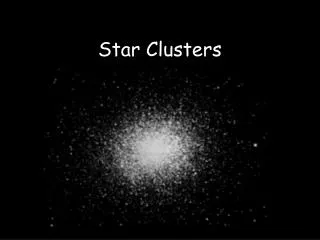
Chapter 13: Star Clusters Stars (almost) always form in clusters globular cluster Open cluster • The stars all formed at the same time • They are all at the same distance • They formed from the same material • Only difference is their masses!
Pleiades Open clusters: Contain < ~ 1000 stars Loosely gravitationally bound together Younger than globular (some still contain O and B stars) More enriched in heavy elements (“Population I” stars)
Open clusters that have become gravitationally unbound are stellar associations. If they continue to have similar proper motion, this is a moving group. Ursa Major moving group
globular clusters: Contains ~1000-106 stars Extremely old: billions of years Population II (low in heavy elements)
Globular cluster M2 “He who cannot see gravity at work here has no soul.” - Richard Feynman
Isochrones: Lines of ‘constant age’ for stars of different masses
Star clusters are useful to: Verify stellar evolution models Determine distances to nearby galaxies Determine chemical composition of universe in the very distant past