Update on California Levee Vegetation Research Program (CLVRP): Progress and Upcoming Activities
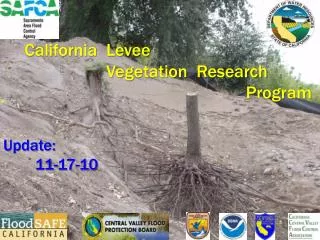
This update outlines the status of the California Levee Vegetation Research Program (CLVRP) as of November 17, 2010. Key developments include an agreement with USGS for T-LiDAR imagery and support for CLVRP principal investigators. A two-day technical working meeting is scheduled for December 14-15, 2010, involving CLVRP sponsors and technical advisors. Observations from the Root Architecture Study highlight species-dependent root behavior, with implications for levee stability and seepage analysis. Upcoming studies include investigations into windthrow, root piping, and burrowing mammals.

Update on California Levee Vegetation Research Program (CLVRP): Progress and Upcoming Activities
E N D
Presentation Transcript
California Levee Vegetation Research Program Update: 11-17-10
Status of CLVRP Work Plans (2) Other: Entered into agreement w/USGS to provide ground based T-LiDAR imagery & support to CLVRP PI’s. Convening 2-day CLVRP technical working meeting on Dec. 14-15, 2010 w/CLVRP sponsoring agencies, PI’s and technical advisors (location TBD).
Tentative Observations • Rootarchitecture is tree species dependent • Oaks tend to keep their root mass within the canopy perimeter and have robust tap roots • Cottonwood roots travel far afield & aggressively search for water and nutrients • Seepage through old stump roots may be slowed • Rodent holes may play a strong role in levee seepage
2011 Upcoming Activities • WindthrowStudy: Season 2 @ Natomas, Nelson Bend, Feather River, Bear River • Tree Root Piping, Seepage, & Slope Stability Study: Season 2 • Burrowing Mammals Study: Season 2 • Levee Failure Forensics Study