Download
1 / 20
200 likes | 309 Vues
This comprehensive overview by Richard Eisner, FAIA, Administrator of the OES Coastal Region & Tsunami Program, explores the phenomena of tsunamis resulting from significant earthquakes, particularly focusing on the M9.3 earthquake in Sumatra. It delves into the mechanics of how earthquakes generate tsunamis and examines the complexities of tsunami inundation challenges, predictions, and warning systems. The program provides a model to understand the impact and protective measures necessary for effective risk management along California's coastline.

E N D
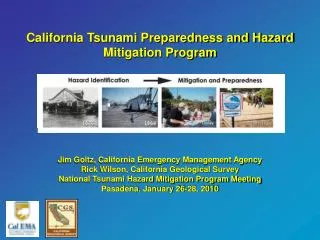
California Tsunami Program Richard Eisner, FAIA, Administrator OES Coastal Region & Tsunami Program
M9.3 Earthquake in Sumatra
Travel Times
How Do Earthquakes Create Tsunamis? • Rapid Sea Floor Deformation and Vertical Displacement • Ocean Above Deformation is Displaced • Waves Form As Displaced Water Levels • Waves Propagate Across Ocean
Non-Tectonic Tsunamis • Landslides • Monterey Bay • Palos Verdes • Santa Barbara • Catalina Island • Undersea Volcanoes • Meteors
What is a Tsunami Wave? • Long Wave Length (>100km) • Long Period (>1 hour) • High Speed (>700 km/hour) • Little Energy Loss Over Great Distance • Grows in Shallow Water
Challenges • Uncertainty • Unpredictability • Possible Warning? • Limited Mitigation Options to Reduce Risk • Systems Depend on State and Federal Support BUT Local Lead • Infrequency -- Recurrence (?)
Prediction and Warning • How Do You Describe The Threat • A Physical Model for Phenomenon by NOAA • Scientific Review by NOAA • Where? • How Big? • Probability of Occurrence? • When? • Impact and Protective Measures?
Will There Be A Tsunami? • Tsunami-genesis Inferred From Earthquake • Magnitude • Location • Mechanism • Historic Record • Tsunami Confirmed by Tide Gages • Distant • In Harbors • And Mid-Ocean NOAA Buoys (DART)
Deep Ocean Assessment and Reporting of Tsunamis (DART) Or “Tsunamometers”