SlideServe
Menu
Préférences
© SlideServe · v2026

Present Perfect Continuous

purity avatar
8 diapositives · 559 Views · Jul 25, 2014

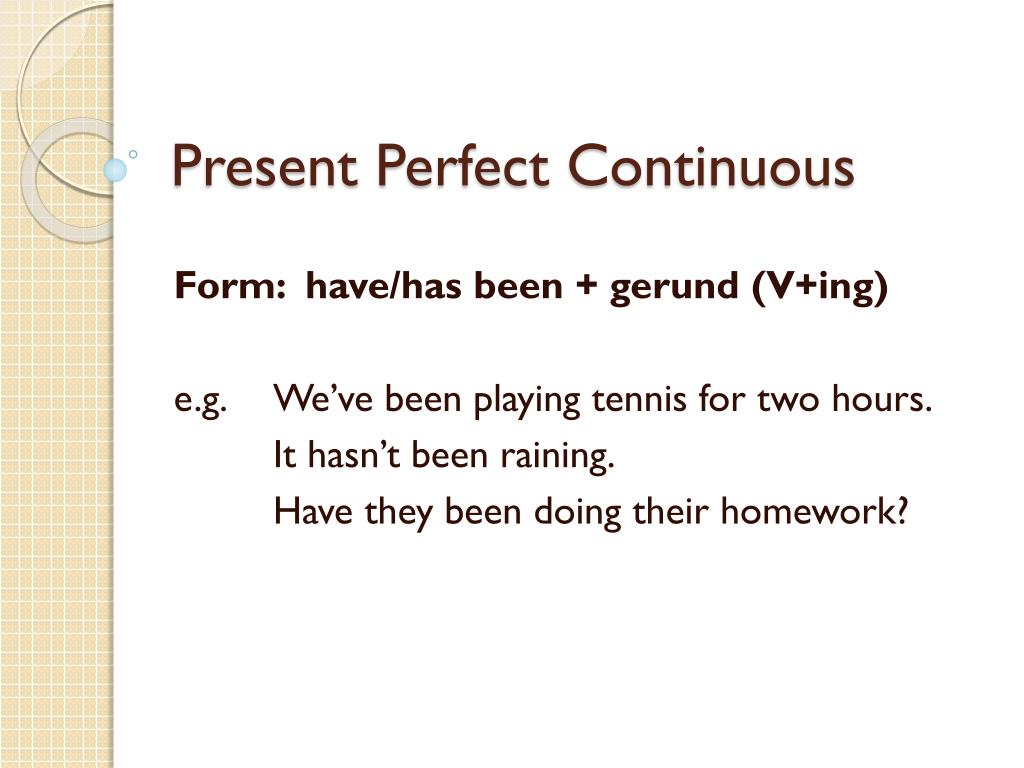
Present Perfect Continuous. Form : have /has been + gerund ( V+ing ) e.g. We’ve been playing tennis for two hours . It hasn’t been raining . Have they been doing their homework ?. Uses.
Present Perfect Continuous - slide 1
01 / 8Present Perfect Continuous
1 / 17

Télécharger la présentation

Present Perfect Continuous
Une image / un lien ci-dessous est fourni (tel quel) pour télécharger la présentation

Politique de téléchargement : le contenu du site vous est fourni TEL QUEL pour votre information et votre usage personnel ; il ne peut être vendu, concédé sous licence ni partagé sur d’autres sites sans l’accord de son auteur.Le contenu vous est fourni TEL QUEL, pour votre information et votre usage personnel uniquement. Téléchargez la présentation en cliquant sur ce lien. Lors du téléchargement, si vous ne parvenez pas à télécharger une présentation, l’éditeur a peut-être supprimé le fichier de son serveur.Pendant le téléchargement, si vous ne parvenez pas à obtenir une présentation, le fichier a peut-être été supprimé par l’éditeur.

F I N

Plus de contenu associé

Transcription de la présentation
  1. PresentPerfectContinuous Form: have/has been + gerund (V+ing) e.g.We’vebeenplayingtennisfortwohours. Ithasn’tbeenraining. Havetheybeendoingtheirhomework?

  2. Uses • 1. Anactionthatstarted in thepast and stoppedrecently. Thereisusually a resultnow. e.gI’mtiredbecauseI’vebeenrunning. Whyisthegrasswet? Has itbeenraining? Youdon’tunderstandbecauseyouhaven’tbeenlistening.

  3. 2. Anactioncontinuing up tonow. Thisisoftenusedwithfororsince e.g. I’ve been reading for 2 hours. [I am still reading now.] We've been studying since 9 o'clock. [We're still studying now.] How long have you been learning English? [You are still learning now.]

  4. PresentPerfect simple orcontinous? 1. Look at these two sentences. • I’ve read that book you lent me. I finished it yesterday. • I’ve been reading that book you lent me. I’ve got another 50 pages to read. Thepresent perfect simple (I’ve read) gives the idea of completion while the present perfect continuous (I’ve been reading) suggests that something is unfinished.

  5. 2. Look at these two sentences. • She’s been writing emails for 3 hours. • She’s written 10 messages. Thepresent perfect continuous (has been writing) talks about how long something has been happening. The present perfect simple (has written) talks about how much/how many have been completed.

  6. 3. Look at these two sentences. • I’ve worked here for thirty years. • I usually work in London but I’ve been working in Birmingham for the last 3 weeks. We can use the present perfect simple to talk about how long when we view something as permanent. But the present perfect continuous is often used to show that something is temporary.

  7. Complete: • I (wash) thewindows, I (sweep) up theleaves, but I (notwash) the car yet. • What (you do)? You’recovered in flour. • Debbie (look) verytiredrecently. (Shework) toohard? • He (notfinished) hishomeworkbecause he (watch) TV forthelasttwohours. • Havewegotanyplasters? I (chop) vegetables fordinner and I (cut) my finger.

  8. Answers: • I’vewashed / I’veswept / I haven’twashed • Whathaveyoubeendoing? • ... has beenlooking / Has shebeenworking ...? • He hasn’tfinished .../ he’sbeenwatching... • I’vebeenchopping .../ I’vecut ...