Introduction to Database Management Systems: Concepts and Applications
This introduction to Database Management Systems (DBMS) explores the essential components and functions of databases, emphasizing their importance in our daily lives. It discusses the historical evolution of database systems from file-based storage to advanced relational models, highlighting the issues related to data redundancy, integrity, and security. The chapter covers various data models, including Entity-Relationship and Relational models, along with definitions of Data Definition Language (DDL) and Data Manipulation Language (DML). It also outlines application architecture and transaction management, ensuring data consistency and reliability.

Introduction to Database Management Systems: Concepts and Applications
E N D
Presentation Transcript
Chapter 1Introduction Yonsei University 1st Semester, 2013 Sanghyun Park
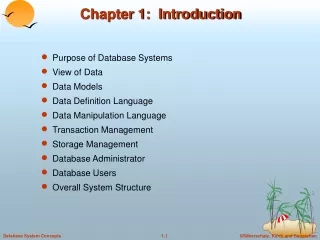
Database Management System (DBMS) • Collection of interrelated data • Set of programs to access the data • DBMS contains information about a particular enterprise • DBMS provides an environment that is both convenient and efficient to use • Databases touch all aspects of our lives
Purpose of Database System • In the early days, database applications were built on top of file systems • Drawbacks of using file systems to store data: • Data redundancy and inconsistency • Difficulty in accessing data • Integrity problems • Atomicity of updates • Concurrent access by multiple users • Security problems • DBMS offers solutions to all the above problems
View of Data • An architecture for a database system
Data Models • A collection of tools for describing • Data • Data relationships • Data semantics • Data constraints • Entity-Relationship model • Relational model • Other models: • Object-oriented model, semi-structured data models • Older models: network model and hierarchical model
Data Definition Language (DDL) • Language for defining the database structure create table instructor (ID char(5),name varchar(20), dept_name varchar(20), salary numeric(8,2) ) • Execution of the above DDL statement creates the instructor table • In addition, it updates a special set of tables called the data dictionary
Data Manipulation Language (DML) • Language for accessing and manipulating the data organized by the appropriate data model • Procedural DMLs require a user to specify what data are needed and how to get those data • Declarative (or Nonprocedural) DMLs require a user to specify what data are needed without specifying how to get those data • It is common to use the terms query language and data manipulation language synonymously • SQL is the most widely used query language
Database Access From Applications • Application programs are programs that are used to interact with the database • Application programs are usually written in a host language, such as Cobol, C, C++, or Java • Application programs generally access databases through one of: • Language extensions to allow embedded SQL • Application program interface (e.g., ODBC/JDBC) which allows SQL queries to be sent to a database
Application Architecture • Two-tier architecture: E.g. client programs using ODBC/JDBC to communicate with a database • Three-tier architecture: E.g. web-based applications
Storage Management • Storage manager is a program module that provides the interface between the low-level data stored in the database and the application programs and queries submitted to the system • Issues • Storage access • File organization • Indexing and hashing
Query Processing • Parsing and translation • Optimization • Evaluation
Transaction Management • What if the system fails? • What if more than one user is concurrently updating the same data? • A transaction is a collection of operations that performs a single logical function in a database application • Transaction-management component ensures that the database remains in a consistent (correct) state despite system failures and transaction failures • Concurrency-control manager controls the interaction among the concurrent transactions, to ensure the consistency of the database
History of Database Systems (1/2) • Late 1960s and 1970s • Network and hierarchical data models in widespread use • Ted Codd defines the relational data model(Win the ACM Turing Award for this work)(IBM Research begins System R prototype)(UC Berkeley begins Ingres prototype) • 1980s • Research relational prototypes evolve into commercial systems(SQL becomes industrial standard) • Parallel and distributed database systems • Object-oriented database systems
History of Database Systems (2/2) • 1990s • Large decision support and data-mining applications • Large multi-terabyte data warehouses • Emergence of Web commerce • 2000s • XML and XQuery standards • Automated database administration