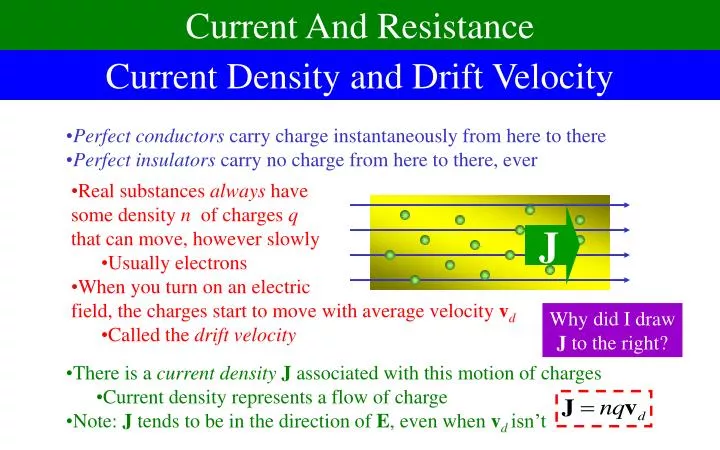

Current Density and Drift Velocity
E N D
Presentation Transcript
Current And Resistance Current Density and Drift Velocity • Perfect conductors carry charge instantaneously from here to there • Perfect insulators carry no charge from here to there, ever • Real substances always havesome density n of charges qthat can move, however slowly • Usually electrons • When you turn on an electricfield, the charges start to move with average velocity vd • Called the drift velocity J Why did I draw J to the right? • There is a current densityJ associated with this motion of charges • Current density represents a flow of charge • Note: J tends to be in the direction of E, even when vdisn’t
Ohm’s Law: Microscopic Version • In general, the stronger the electric field, the faster the charge carriers drift • The relationship is often proportional • Ohm’s Law says that it is proportional • Ohm’s Law doesn’t always apply • The proportionality constant, denoted , is called the resistivity • It has nothing to do with charge density, even though it has the same symbol • It depends (strongly) on the substance used and (weakly) on the temperature • Resistivities vary over many orders of magnitude • Silver: = 1.5910-8 m, a nearly perfect conductor • Fused Quartz: = 7.51017 m, a nearly perfect insulator • Silicon: = 640 m, a semi-conductor Ignore units for now
The Drude Model • Why do we (often) have a simple relationshipbetween electric field and current density? • In the absence of electric fields, electrons are moving randomly at high speeds • Electrons collide with impurities/imperfections/vibrating atoms and change their direction randomly • When they collide, their velocity changes to a random velocity vi • Between collisions, the velocity is constant • On average, the velocity at any given time is zero • Now turn on an electric field • The electron still scatters in a random direction at each collision • But between collisions it accelerates • Let be the average time since the last collision
Current • It is rare we are interested in the microscopic current density • We want to know about the total flow of charge through some object J • The total amount of charge flowing out of an object is called the current • What are the units of I? • The ampere or amp (A) is 1 C/s • Current represents a change in charge • Almost always, this charge is beingreplaced somehow, so there is noaccumulation of charge anywhere
Ohm’s Law for Resistors • Suppose we have a cylinder of material with conducting end caps • Length L, cross-sectionalarea A • The material will be assumed to follow Ohm’s Microscopic Law L • Apply a voltage Vacross it • Define the resistance as • Then we have Ohm’s Law for devices • Just like microscopic Ohm’s Law, doesn’t always work • Resistance depends on composition, temperature and geometry • We can control it by manufacture • Resistance has units of Volts/Amps • Also called an Ohm () • An Ohm isn’t much resistance Circuit diagram for resistor
Ohm’s Law and Temperature • Resistivity depends on composition and temperature • If you look up the resistivity for a substance, it would have to give it at some reference temperature T0 • Normally 20C • For temperatures not too far from 20 C, we can hope that resistivity will be approximately linear in temperature • Look up 0 and in tables • For devices, it follows there will also be temperature dependence • The constants and T0 will be the same for the device
Non-Ohmic Devices • Some of the most interesting devices do not follow Ohm’s Law • Diodes are devices that let current through one way much more easily than the other way • Superconductors are cold materials that have no resistance at all • They can carrycurrent foreverwith no electricfield
Power and Resistors • The charges flowing through a resistor are having their potential energy changed Q • Where is the energy going? • The charge carriers are bumping against atoms • They heat the resistor up V
Uses for Resistors • You can make heating devices using resistors • Toasters, incandescent light bulbs, fuses • You can measure temperature by measuring changes in resistance • Resistance-temperature devices • Resistors are used whenever you want a linear relationship between potential and current • They are cheap • They are useful • They appear in virtually every electronic circuit
Equations for Test 1 Electric Fields: Gauss’s Law: Potential: Capacitance: Units: End of material for Test 1