
Uploaded by
quinn-heath
1 SLIDES
153 VUES
10LIKES
Understanding Protein Kinase Activity: The Role of ATP and ADP in Phosphorylation
DESCRIPTION
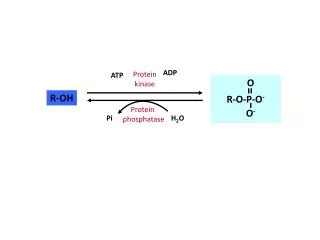
This overview explores the mechanisms of protein kinases and phosphatases in cellular processes. Protein kinases catalyze the transfer of phosphate groups from ATP to specific substrates, leading to phosphorylation, a critical regulatory mechanism in various biological functions. Conversely, protein phosphatases remove these phosphate groups, often deactivating or activating pathways and proteins. We delve into the significance of adenosine triphosphate (ATP), adenosine diphosphate (ADP), inorganic phosphate (Pi), and water (H2O) in these biochemical reactions, highlighting their pivotal roles in cellular signaling.
Download
1 / 1
Télécharger la présentation 
Understanding Protein Kinase Activity: The Role of ATP and ADP in Phosphorylation
An Image/Link below is provided (as is) to download presentation
Download Policy: Content on the Website is provided to you AS IS for your information and personal use and may not be sold / licensed / shared on other websites without getting consent from its author.
Content is provided to you AS IS for your information and personal use only.
Download presentation by click this link.
While downloading, if for some reason you are not able to download a presentation, the publisher may have deleted the file from their server.
During download, if you can't get a presentation, the file might be deleted by the publisher.
E N D














More Related