Download
1 / 21
210 likes | 324 Vues
This document explores the critical need for improved health care information sharing for children in foster care. It highlights the role of Electronic Information Exchange (EIE) in addressing the unique health challenges faced by these children, including access to comprehensive health records and improved communication among service providers. Strategies for developing EIE systems, exemplified by the Ventura County Foster Health Link, are discussed along with potential benefits such as enhanced health outcomes, reduced costs, and better preventive care.

E N D
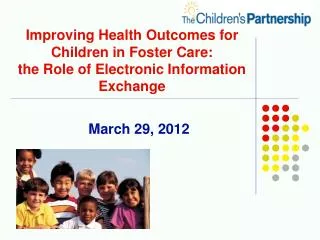
Improving Health Outcomes for Children in Foster Care: the Role of Electronic Information Exchange March 29, 2012
Overview • Need for improved information sharing in the provision of health care services to children in foster care • How electronic information exchange (EIE) can be used to improve health outcomes • Strategies for developing EIE for children in foster care • Ventura County Foster Health Link: an EIE demonstration project
About The Children’s Partnership (TCP) • TCP is a national nonprofit, nonpartisan child advocacy organization with offices in California and Washington, DC • Mission is to ensure that all children grow up to lead healthy and lead productive lives • Expertise in research, analysis and policy development to benefit all children, especially the underserved • Expertise includes
About TCP (cont’d) • Primary focus has been on securing health coverage for uninsured children and expanding access to technology to underserved children • TCP’s e-health work includes development of Express Lane eligibility and enrollment system, telehealth, electronic record systems, and now, foster care coordination
Health Care Challenges Facing Children in Foster Care • Large number of children in care • Poor health status and significant unmet health care needs • Greater utilization of services and disproportionately high health care expenditures • Fragmented care and poor health outcomes
Factors Contributing to Inadequate Health Care and Poor Outcomes • Placement instability and variability • Resource and staff limitations in child welfare services • Lack of coordination and information sharing between service providers
Electronic Information Exchange (EIE): The Means to a Solution • EIE can support information sharing and address coordination gaps • EIE can support provider practice changes, especially through the use of electronic health records • EIE can help assess the changing health status and needs of a population
Why Development of EIE for Children in Foster Care Should be a Priority • Gives providers access to more comprehensive information about a child • Facilitates communication between providers for purposes of coordinating care and delivery of services • Provides youth with a record of health conditions and services received as they prepare for permanency or emancipation
Basic Elements of EIE for Children in Foster Care • Data Included • Basic health information including allergies, immunizations, diagnoses, and provider contact information • Medical service claims, pharmacy claims, lab data • Access • Medical providers, child welfare workers, foster parents and foster youth
Basic Elements of EIE for Children in Foster Care (cont’d) • Additional Functions • Reminders about a child’s needs, warnings of gaps in care or medication interactions • Potential for Expansion • EIE can be expanded to include other responsible entities such as schools and courts, with appropriate safeguards
Early Evidence Supports Use of EIE for Children in Foster Care • Improved Health Outcomes • Better preventive care • Decreased hospital stays • Improved clinical conditions • Cost Savings • Decrease in expensive avoidable illness and hospital stays • Reduction in pharmacy costs
Strategies for Developing EIE for Children in Foster Care • Identify public and private funding • Medicaid, including Early and Periodic Screening, Diagnosis, and Treatment (EPSDT), Medicaid Management Information Systems, and standard Medicaid administrative match • HITECH, including Innovation Grants • State and county sources • Private funding, primarily foundation grants
Strategies for Developing EIE for Children in Foster Care (cont’d) • Identify and develop stakeholders and strong leadership • Development process may be long and require complex negotiations • Involve stakeholders, including foster parents and youth, early in the process • Programmatic champions from state and local government help drive the process
Strategies for Developing EIE for Children in Foster Care (cont’d) • Address privacy and confidentiality concerns early and often • Laws are complex and there are unique and varied privacy concerns for children in foster care • Key considerations: • Who controls information into and out from EIE? • Who has access to information contained in the EIE? • What role do foster parents and youth play in contributing to and controlling information in the EIE?
Strategies for Developing EIE for Children in Foster Care (cont’d) • Scope EIE Project Appropriately • Important to balance need for including enough information to improve outcomes with need to avoid including so much information the system becomes unwieldy • Select an EIE architecture that allows a narrow approach at first and broadening of scope over time
Strategies for Developing EIE for Children in Foster Care (cont’d) • Discuss evaluation and sustainability early in EIE development • Important to build key evidence base to demonstrate improved outcomes and cost savings as soon as possible • Long-term sustainability depends on: • Secure funding • Engaged leadership and stakeholders • Clear privacy and confidentiality protections • Demonstrated improved outcomes and cost savings
Ventura County Foster Health Link (VCFHL): an EIE Demonstration Project • Why Ventura County? • Manageable size—population of about 825,000 (2010) with about 800 children in foster care • County-operated system of hospitals and clinics—ease of implementation • Strong leadership in both county human services and health care agencies
VCFHL Project (cont’d) • Primary Goals: • Connect health and child welfare information for all children in foster care • Leverage existing technology • Provide appropriate access to real-time information
VCFHL Project (cont’d) • Key Components • Master Person Index • Record Locator Service • “Youth-facing” Portal • Interface with state CWS and health databases
VCFHL Project (cont’d) • Current Status and Next Steps: • Partnering with State for $1 million federal Medicaid HIE funding; submission of IAPD-U • Nonfederal $100,000 match in place—county funds and foundation grants • Governance structure for EIE developed; developing MOUs and contracts • Once federal funding received, 22-month project timeline
For more information • TCP Website: • www.childrenspartnership.org • Contact me: • Ginny Puddefoot, Director HIT Initiatives for Vulnerable Children The Children’s Partnership 916-572-7340 gpuddefoot@childrenspartnership.org