

SlideServe
Menu
Préférences
© SlideServe · v2026

Lab on a Chip

quito avatar
15 diapositives · 999 Views · Aug 22, 2014

Lab on a Chip. Dr. Eric Lagally lagally@msl.ubc.ca. Or: The Incredible Shrinking Science Experiment! Or: APOIBE!. Credits: Mathies Lab, UC-Berkeley Quake Lab, Stanford Agilent, Inc. Lab on a Chip?. Microfluidics.
Lab on a Chip - slide 1
01 / 15Lab on a Chip
1 / 17

Télécharger la présentation

Lab on a Chip
Une image / un lien ci-dessous est fourni (tel quel) pour télécharger la présentation

Politique de téléchargement : le contenu du site vous est fourni TEL QUEL pour votre information et votre usage personnel ; il ne peut être vendu, concédé sous licence ni partagé sur d’autres sites sans l’accord de son auteur.Le contenu vous est fourni TEL QUEL, pour votre information et votre usage personnel uniquement. Téléchargez la présentation en cliquant sur ce lien. Lors du téléchargement, si vous ne parvenez pas à télécharger une présentation, l’éditeur a peut-être supprimé le fichier de son serveur.Pendant le téléchargement, si vous ne parvenez pas à obtenir une présentation, le fichier a peut-être été supprimé par l’éditeur.

F I N

Plus de contenu associé

Transcription de la présentation
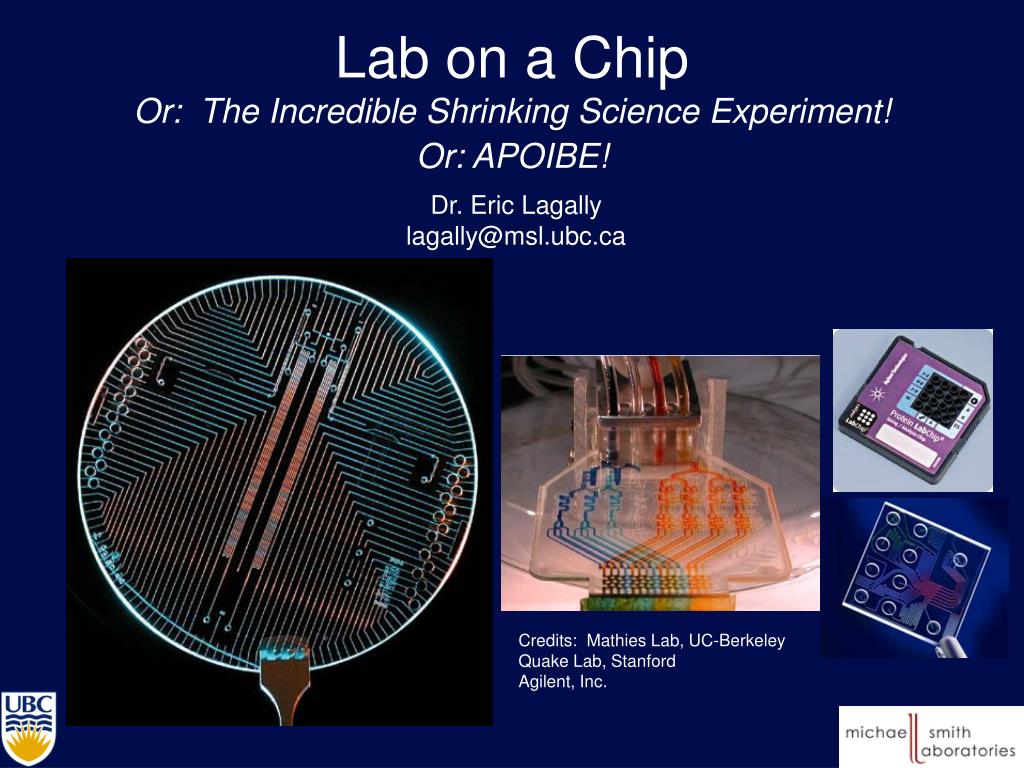
  1. Lab on a Chip Dr. Eric Lagally lagally@msl.ubc.ca Or: The Incredible Shrinking Science Experiment! Or: APOIBE! Credits: Mathies Lab, UC-Berkeley Quake Lab, Stanford Agilent, Inc.

  2. Lab on a Chip?

  3. Microfluidics Microfluidics: The use of microfabrication techniques from the IC industry to fabricate channels, chambers, reactors, and active components on the size scale of the width of a human hair or smaller Credit: Dr. Karen Cheung, UBC ECE

  4. Why use microfluidics? Credit: Dr. Karen Cheung, UBC ECE 1 molecule in 1 mL = 1.6 x 10⁻¹⁸ M 1 molecule in 1 nL = 1.6 x 10⁻¹⁵ M 1 molecule in 1 pL = 1.6 x 10⁻¹² M

  5. Why use microfluidics? • Sample savings – nL of enzyme, not mL • Faster analyses – can heat, cool small volumes quickly • Integration – combine lots of steps onto a single device • Novel physics – diffusion, surface tension, and surface effects dominate • This can actually lead to faster reactions!

  6. Some interesting LOC applications • Genetic analysis • Portable devices for pathogen detection • High-throughput biology • Chemical synthesis • Metabolite analysis • Drug delivery systems Courtesy of Dr. Boris Stoeber

  7. Genetic analysis microsystems

  8. Bacterial Pathogens Wound infections Lung Disease Food poisoning Dr. Sharon Peacock, University of Oxford Biowarfare Food poisoning: Pathogenic E. coli: >1 in 10,000 in Canada Salmonella spp.: as high as 1 in 50 eggs Wound infections: Antibiotic-resistant S. aureus: as high as 50% Lung Disease: Pseudomonas spp. Mycobacterium tuberculosis Biowarfare: Anthrax, plague, smallpox

  9. Methods for Genetic Detection of Pathogens OLD WAY: NEW WAY: Develop bacterial pathogen detectors that are: Rapid (< 1 hour) General (many different types of pathogens) Sensitive (detect a single cell) Genetically Specific Field-portable

  10. PCR-CE Microsystem Fabrication

  11. Portable System for Infectious Disease Detection System measures 8 x 10 x 12 inches • Complete fluorescence detection including 488-nm solid-state laser, PMT, optics, and detection electronics • Heater and RTD electronics • 4 high-voltage CE power supplies • PDMS microvalve hardware • Simple PC interface

  12. Thermal Cycling Characteristics Temperature (°C) Time (seconds) Time (seconds) > 5X faster than conventional thermal cyclers

  13. Doctors Without Borders: Disease caused by Mycobacterium tuberculosis 9 million new cases of active TB every year worldwide 2 million TB deaths every year 450,000 new cases of multi-drug resistant TB / yr 10% of TB cases in South Africa are XDR TB strains, resistant to first- and second-line antibiotics Application: Tuberculosis (TB) detection

  14. Current TB detection methods • 1. Fixation and staining with acid-fast stains • (Ziehl-Neelsen or auramine stains) • 2. Optical or fluorescence microscope • examination ( 10,000 organisms/mL) • Culture in biosafety level 3 containment • facility In select cases, molecular detection is used to verify diagnosis "That TB destroys millions of lives around the world every year shows that the current approach is just not working…The tools we have to treat and diagnose TB are woefully inadequate and outdated, and we're not seeing the necessary urgency to tackle the disease." Dr. Tido von Schoen-Angerer, Director, DWB’s Campaign for the Access to Essential Medicines

  15. 2308?? Paramount The Not-so-Distant Future 2008 PDA