The Power of Self-Persuasion: Insights from Advertising and the Elaboration Likelihood Model
100 likes | 208 Vues
This exploration delves into self-persuasion principles and advertising philosophies, particularly through the lens of the Elaboration Likelihood Model (ELM). It examines how attitude polarization, role playing, and indirect persuasion shape consumer behavior. Focusing on motivation and ability to elaborate, we dissect central and peripheral routes to persuasion, influencing consumer involvement. Insights from renowned ad agency Leo Burnett's characters exemplify effective advertising strategies. Understanding these concepts equips marketers and advertisers with tools to create compelling campaigns.


The Power of Self-Persuasion: Insights from Advertising and the Elaboration Likelihood Model
E N D
Presentation Transcript
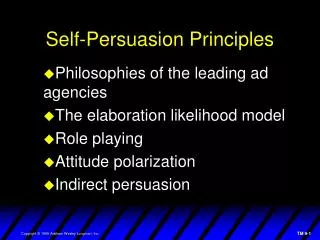
Self-Persuasion Principles Philosophies of the leading ad agencies The elaboration likelihood model Role playing Attitude polarization Indirect persuasion
The elaboration likelihood model of persuasion Exposure to advertising Motivation to elaborate (depends on involvement, need for cognition, etc.) Low motivation Low ability Ability to elaborate (depends on knowledge, comprehensibility, distraction, etc.) Peripheral Route (minimal processing and simple inferencing) Central route (effortful processing of information central to the true merits of an attitudinal position)
Determinants of the route to persuasion and attitude strength Motivation High Low Central Route Peripheral Route High Ability (strong attitudes) (weak attitudes) Peripheral Route Peripheral Route Low (weak attitudes) (weak attitudes)
Product attributes Low High Involvement Involvement Low High Involvement Involvement
Indirect persuasion Response latency to questions about conclusions Moderate incongruity Moderate incongruity 4722 4520 4503 Congruity 4413 Congruity Explicit Explicit Explicit Explicit Implicit Implicit Explicit Conclusions/High Conclusions/High Conclusions/Low Conclusions/Low Conclusions/High Conclusions/High Conclusions/Low Conclusions/Low Involvement Involvement Involvement involvement Involvement Involvement involvement Involvement
Indirect persuasion Response latency to questions about attitudes Moderate incongruity Moderate incongruity 2734 2431 2063 2459 Congruity Congruity Explicit Explicit Explicit Explicit Explicit Explicit Explicit Explicit Conclusions/High Conclusions/High Conclusions/Low Conclusions/Low Conclusions/High Conclusions/High Conclusions/Low Conclusions/Low Involvement Involvement Involvement involvement Involvement Involvement involvement Involvement