Understanding Sequence Recognition and Trait Prediction in Genetics
This presentation delves into the principles of sequence recognition and trait prediction using Bayes' theorem. It explains how to calculate the posterior probability of a trait M given a sequence s (P(M|s)) by considering prior probabilities and standardized likelihoods. The importance of monogenic traits, such as obesity, is discussed alongside their statistical significance. Models of genotype predictions are illustrated, emphasizing Hardy-Weinberg equilibrium and the factors that influence genetic traits. Key terms and foundational concepts are briefly outlined for clarity.

Understanding Sequence Recognition and Trait Prediction in Genetics
E N D
Presentation Transcript
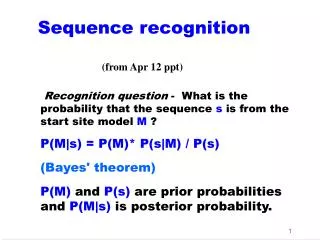
Sequence recognition (from Apr 12 ppt) Recognition question - What is the probability that the sequence s is from the start site model M ? P(M|s) = P(M)* P(s|M) / P(s) (Bayes' theorem) P(M) and P(s) are prior probabilities and P(M|s) is posterior probability.
Trait prediction Probability of trait M given sequence s P(M|s) = P(M)* [P(s|M) / P(s)] Posterior = Prior * [standardized likelihood] Probability predicts unknown outcomes based on known parameters. Likelihood estimates unknown parameters based on known outcomes.
Trait prediction Probability of trait M given sequence s P(M|s) = P(M)* [P(s|M) / P(s)] Monogenic: 1 = 1E-4 *[7E-2 /7E-7] “Monogenic forms of obesity at present account for approximately 7% of children with severe, young-onset obesity (3), but as this severity of obesity is only seen in <0.01% of the population .. 66% of the U.S. population had a BMI ≥ 25 kg/m2 and 32% were obese .. FTO: The 16% of adults who are homozygous for the risk allele weighed about 3 kilograms more and had a 1.67-fold increased risk of obesity” . --Frayling et al. Science 12 April 2007 FTO: 1.67*0.32 = .32 * [ .265/.16]
Trait prediction given diploid s A likely scenario: Not in OMIM & heterozygous P(deleterious | s) e.g. polyphen P(dominant | s) P(epistatic | s)
OMIM stats Dominant= 4170, recessive 3674 hits
Genotype % chances if a subject has one copy of a (co)dominant allele "Aa" & most people are "aa". Family Risks
Genotype % chances if a subject has 2 copies of a (co)dominant allele "AA" & most people are "aa". Family Risks
Hardy–Weinberg equilibrium • Assumptions: • Diploid • Trait is autosomal • Is sexually reproducing, either monoecious or dioecious • Discrete generations • Random mating within a single population • Population size sufficiently large so to minimize effect of genetic drift • No selection, mutation, migration
PhenotypeGeneticsallele interactions, epistasis http://galitski.systemsbiology.net//