Understanding Differentiation and Integration of Particle Motion
210 likes | 334 Vues
This guide explores the principles of differentiation and integration in relation to particle motion along a line. It covers the concepts of position, velocity, and acceleration, alongside the application of the product and quotient rules. The section includes practical problems, such as finding the particle's position at a given time, its initial velocity, and acceleration. Additionally, it addresses concepts like instantaneous versus average velocity and discusses Pythagorean and double angle identities, making it a comprehensive resource for students of calculus.


Understanding Differentiation and Integration of Particle Motion
E N D
Presentation Transcript
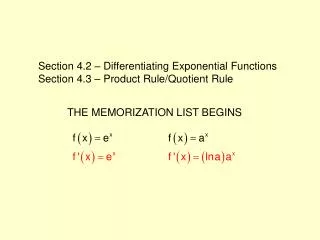
Section 4.2 – Differentiating Exponential Functions Section 4.3 – Product Rule/Quotient Rule THE MEMORIZATION LIST BEGINS
DIFFERENTIATE POSITION s(t) VELOCITY v(t) ACCELERATION a(t) INTEGRATE
No Calculator A particle moves along a line so that at time t, 0 < t < 5, its position is given by a) Find the position of the particle at t = 2 b) What is the initial velocity? (Hint: velocity at t = 0) c) What is the acceleration of the particle at t = 2
CALCULATOR REQUIRED Suppose a particle is moving along a coordinate line and its position at time t is given by For what value of t in the interval [1, 4] is the instantaneous velocity equal to the average velocity? a) 2.00 b) 2.11 c) 2.22 d) 2.33 e) 2.44
NO CALCULATOR An equation of the normal to the graph of
NO CALCULATOR Consider the function A) 5 B) 4 C) 3 D) 2 E) 1
The Basics Pythagorean Identities Double Angle Identities
NO CALCULATOR At x = 0, which of the following is true of • f is increasing • f is decreasing • f is discontinuous • f is concave up • f is concave down X X X
NO CALCULATOR If the average rate of change of a function f over the interval from x = 2 to x = 2 + h is given by A) -1 B) 0 C) 1 D) 2 E) 3
NO CALCULATOR The graph of has an inflection point whenever
NO CALCULATOR then an equation of the line tangent to the graph of F at the point where