Download
1 / 14
150 likes | 273 Vues
Recombinant DNA technology, a cornerstone of modern biotechnology, allows for the transfer of foreign genes into host organisms, particularly bacteria, enabling mass production of vital proteins like insulin for diabetes treatment. This innovation traces its roots back 10,000 years when humans first harnessed microorganisms for food production. Through a series of methodical steps, including gene identification, restriction enzyme application, and plasmid fusion, researchers can create genetically modified organisms with enhanced traits, such as bioengineered foods and medical advancements, significantly improving societal outcomes.

E N D
Creating Recombinant DNA AP Biology Biotechnology Unit Seefloth
Biotechnology • Uses living organisms • Improves society • EX: Medicine, antibody production for cancer treatments, engineered food • Not a “new thing” • Use of micro-organisms is 10,000 years old • Bread (yeast), cheese (bacteria), beer (yeast)
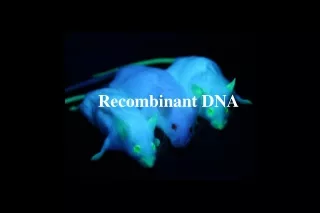
biotechnology Yeast in bread Bacteria curdles cheese Glow Fish with Jelly Fish Gene GFP gene
Recombinant DNA Technology • Produces large amounts of substances • Transfers a foreign gene into a host organism (bacteria is preferred) • Host reproduces, passing on the gene in large #s • Many foreign genes = a lot of new protein exists • EX: E.colibacteria contains human insulin gene and large amount of insulin can be harvested for diabetic patients
Where to begin? • Step One: identify the gene of interest– what protein do they need manufactured? • Look at the protein and identify the amino sequence of that protein • Locate the complimentary sequence on the mRA • Backtrack to DNA and find the original sequence
Step 2: Use restriction enzyme(s) to cleave the desired gene from the DNA • Need a “sticky end” cut to ensure this gene can be fused into the host organism’s DNA
We need a way to transfer the gene into the host, so…. • Step 3: Locate a plasmid • Use a gene “taxi” from bacteria called a PLASMID (circular DNA). • Create sticky ends on either side of the plasmid so it can fuse with the gene of interest • Plasmids have a replication origin that copies the same plasmid again and again
Step 4: Fuse the plasmid and the gene together • Utilizes the enzyme, Ligase (glue)= phosphodiester linkages • Complimentary base pairs are joined together
Step 5: Mix the plasmids with the host bacteria and test to see if successful • How to know if this worked? • Need a visual cue– antibiotic resistance (clearly grows on a medium that would normally kill them) • Glows green? The GFP (green fluorescent protein) is a visual marker • Test plasmid