Understanding Eukaryotic Cell Structures and Functions: Key Organelles
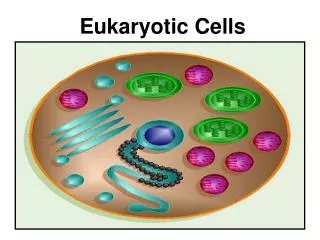
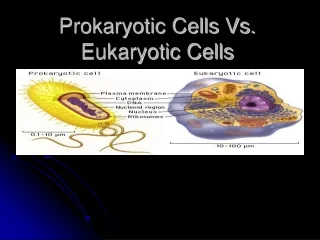
This section explores the internal structure of eukaryotic cells, focusing on organelles involved in protein processing and their functions. Key components include the cytoskeleton, which provides support and aids in transport and movement, and the nucleus, which stores genetic information. We differentiate between rough and smooth endoplasmic reticulum, ribosomes, Golgi apparatus, and lysosomes, each playing vital roles in cellular processes. Additionally, we compare plant and animal cells, highlighting differences such as cell walls, chloroplasts, and central vacuoles for a comprehensive understanding of eukaryotic biology.

Understanding Eukaryotic Cell Structures and Functions: Key Organelles
E N D
Presentation Transcript
Objectives for section 3-2 • Describe a cell’s internal structure • Identify the organelles responsible for processing proteins • State specific organelle functions • Differentiate between plant and animal cells
Cells have an internal structure. The cytoskeleton has many functions.
Cells have an internal structure. • The cytoskeleton has many functions. • supports and shapes cell • helps position and transport organelles • provides strength • assists in cell division • aids in cell movement
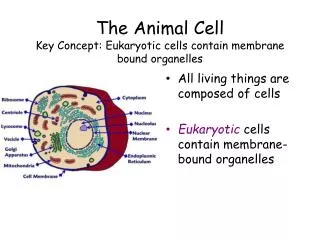
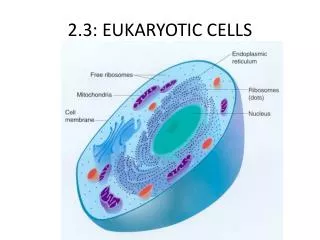
Several organelles are involved in making and processing proteins. • The nucleus stores genetic information. DNA!
Several organelles are involved in making and processing proteins. • Many processes occur in the endoplasmic reticulum. • Similar to a highway system
Several organelles are involved in making and processing proteins. • There are two types of endoplasmic reticulum. • rough (ribosomes) endoplasmic reticulum • smooth endoplasmic reticulum
Several organelles are involved in making and processing proteins. (continued) • Ribosomes link amino acids to form proteins.
Several organelles are involved in making and processing proteins. (continued) • Golgi Apparatus processes, sorts, and delivers proteins. • Similar to a packaging center (UPS)
Several organelles are involved in making and processing proteins. (continued) • Vesicles are membrane-bound sacs that hold materials. • Often paired with Golgi Apparatus vesicles
Other organelles have various functions. • Mitochondria supply energy to the cell. • Powerhouse of the cell - “Mighty Mitochondria” • Has own DNA
Other organelles have various functions. • Vacuoles are fluid-filled sacs that hold materials.
Other organelles have various functions. • Lysosomes contain enzymes to digest material. • Similar to sanitation department
Other organelles have various functions. • Centrioles are tubes found in the centrosomes. • Centrioles help divide DNA. • Centrioles form cilia and flagella. top view Side view
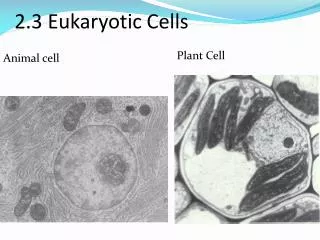
Plant differ from animal cells in three ways: cell walls, chloroplasts, and large central vacuole. • A cell wall provides rigid support.
Plant differ from animal cells in three ways: cell walls, chloroplasts, and large central vacuole. • Chloroplasts convert solar energy to chemical energy. • Has own DNA
Plant differ from animal cells in three ways: cell walls, chloroplasts, and large central vacuole. • Large central vacuole stores water