Download
1 / 26
260 likes | 370 Vues
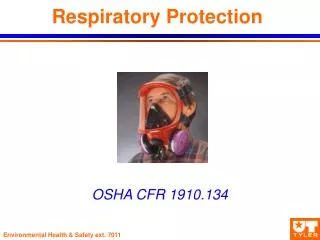
Respiratory Protection. Why respiratory protection is necessary. Air contaminants/hazardous atmospheres come from a variety of sources dusts aerosol mists metal fumes. 1a. Why respiratory protection is necessary. Air contaminants/hazardous atmospheres come from a variety of sources

E N D
Why respiratory protection is necessary • Air contaminants/hazardous atmospheres come from a variety of sources • dusts • aerosol mists • metal fumes 1a
Why respiratory protection is necessary • Air contaminants/hazardous atmospheres come from a variety of sources • evaporated vapors • released gases • oxygen-deficient atmospheres 1b
Why respiratory protection is necessary • Many operations generate air contaminants • filling bins with flour • degreasing metal parts • spraying operations • welding 1c
Why respiratory protection is necessary • Find out how much contaminant is in the air • Test the air to find out what the exposures are 1d
Why respiratory protection is necessary • If results show an overexposure, take steps to control the hazard • engineering controls • administrative controls • PPE 1e
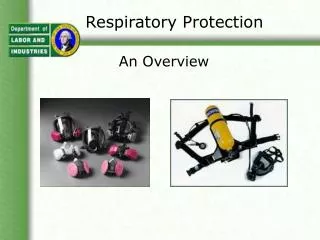
Respirator types • Atmosphere-supplying • supplied air • self-contained breathing apparatus (SCBA) • demand • positive pressure • escape-only 2a
Respirator types • Air-purifying • filter • canister or cartridge 2b
Respirator types • Air-purifying • negative pressure • powered air-purifying 2c
Fit, usage, and maintenance • Employees must pass a fit test • quantitative fit • qualitative fit • Use the respirator as it was designed 3a
Fit, usage, and maintenance • Follow operating instructions • If respirators are used to enter an IDLH atmosphere: • one trained, rescue-equipped employee must remain outside • an attendant must maintain communication contact 3b
Fit, usage, and maintenance • During interior structural firefighting • at least 2 employees with SCBA must enter together and stay in contact with each other • at least two people trained and equipped for rescue must remain outside 3c
Fit, usage, and maintenance • A dirty, inoperative respirator will not protect you 3d
Inspection, donning, doffing respirators • Inspect respirators before each use and during cleaning • Inspect SCBAs monthly and keep cylinders fully charged 4a
Inspection, donning, doffing respirators • Emergency-use respirators: • inspect monthly • tags must show inspection results • Follow instructions to inspect and don/doff equipment 4b
Inspection, donning, doffing respirators • Perform seal checks after donning respirator • positive pressure test • negative pressure test • review Appendix B-1 • Never enter a work area without a good respirator seal 4c
Cleaning, maintenance, and storage • Respirators must be cleaned to remove contaminants/prevent irritation • Shared respirators must be cleaned before each use 5a
Cleaning, maintenance, and storage • Emergency-use respirators must be cleaned after each use • Review Appendix B-2 for cleaning/disinfecting instructions • Only use manufacturer’s replacement parts 5b
Storage helps prevent respirators from: Damage Contamination Dust Sunlight Temperature extremes Excessive moisture Chemicals Deformation of the facepiece Cleaning, maintenance, and storage 5c
Responding to emergencies • If the respirator malfunctions, immediately leave the work area • Activate auxiliary self-contained air supply 6a
Responding to emergencies • If a sudden hazardous release occurs, don emergency escape-only respirators as you exit the area 6b
Responding to emergencies • Some employees must be trained and authorized to respond to emergency situations • confined space rescue • release of hazardous chemicals • interior structure firefighting 6c
Medical signs and symptoms • Know how to recognize and report medical signs and symptoms that may limit or prevent the effective use of respirators • Shortness of breath • Dizziness 7a
Medical signs and symptoms • Coughing • Wheezing • Chest pain 7b
Medical signs and symptoms • Chest injuries • Lung diseases • Cardiovascular conditions 7c
Medical signs and symptoms • Heart conditions • Review Appendix C: OSHA Respirator Medical Evaluation Questionnaire 7d