Download
1 / 11
110 likes | 201 Vues
Explore the intricate workings of the nervous system, including neurons, how impulses move, and the role of the brain in controlling bodily functions. Learn about stimuli, homeostasis, types of nerve cells, nervous system divisions, reflexes, and the impact of multiple sclerosis.

E N D
Stimuli and Homeostasis • A stimulus is an internal or external change that brings about a response • Your nervous system helps your body adjust to changing stimuli • Homeostasis is the regulation of steady, life maintaining conditions within an organism, despite changes within its environment • Example: regulation of breathing and heartbeat
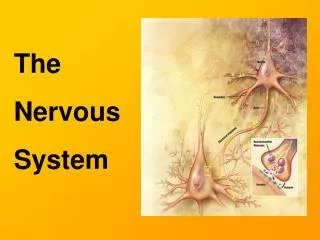
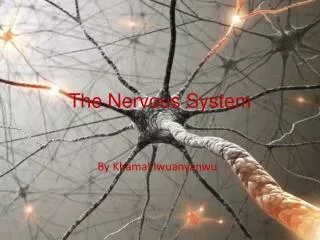
Nerve Cells • Neurons, or nerve cells, are the basic units of the nervous system • A neuron is made up of a cell body, branches called dendrites, and axons • Any message carried by a neuron is an impulse • Impulses move in only one direction • Dendrites receive impulses from other neurons and send them to the cell body • Axons carry impulses away from the cell body
Types of Nerve Cells • Sensory neurons receive information and send impulses to the brain or spinal cord • Interneurons send the impulses to motor neurons • Motor neurons send impulses from the brain or spinal cord to muscles throughout your body
How Impulses Move • Neurons do not touch each other • Neurons are separated from each other by a small space called a synapse • When an impulse reaches the end of an axon, the axon releases a chemical • The chemical flows across the synapse and stimulates an impulse in the dendrite of the next neuron
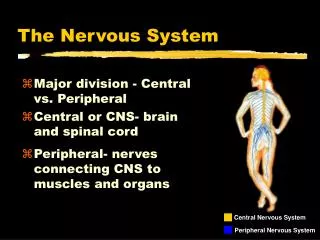
Divisions of the Nervous System • Two major divisions: the central nervous system and the peripheral nervous system • The central nervous system is made up of the brain and spinal cord • The brain is the control center for all activities in the body • Made up of billions of neurons • Spinal cord is made up of bundles of neurons
Peripheral Nervous System • All the nerves outside the CNS that connect the brain and spinal cord to other body parts are part of the peripheral nervous system • Peripheral nerves branch out from the spinal cord and connect to the rest of the body • Two major parts • The somatic system controls voluntary actions • The autonomic system controls involuntary actions
Reflexes • A reflex is an involuntary, automatic response to a stimulus • Allows the body to respond without having to think about what action to take • Reflexes are controlled in the spinal cord, not the brain
The Brain • Made up of three main parts • The cerebrum controls thoughts and voluntary actions • Receives the sensations produced by your senses • The cerebellum controls balance and coordination • The brain stem controls involuntary processes
Multiple Sclerosis • A disease that eats away at the protective covering of your neurons • Interferes with the communication between your brain and your body