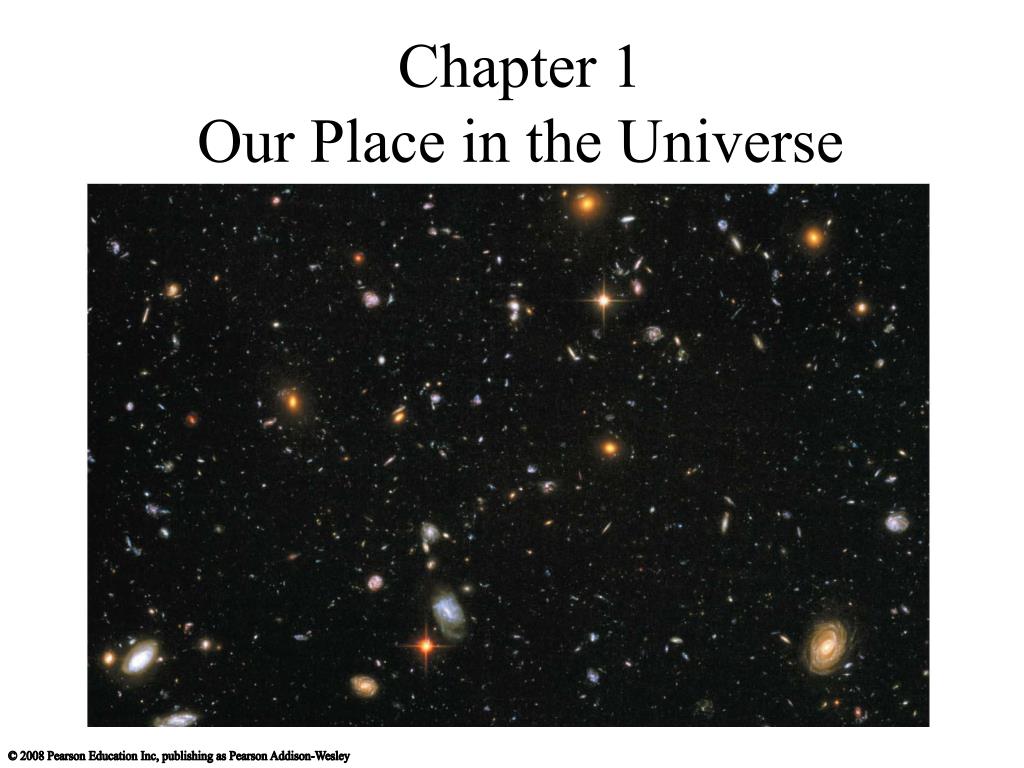
Chapter 1 Our Place in the Universe. 1.1 A Modern View of the Universe. Our goals for learning:. What is our place in the universe? How did we come to be? How can we know what the universe was like in the past? Can we see the entire universe?. What is our place in the universe?. Star.
Une image / un lien ci-dessous est fourni (tel quel) pour télécharger la présentation
Politique de téléchargement : le contenu du site vous est fourni TEL QUEL pour votre information et votre usage personnel ; il ne peut être vendu, concédé sous licence ni partagé sur d’autres sites sans l’accord de son auteur.Le contenu vous est fourni TEL QUEL, pour votre information et votre usage personnel uniquement.Téléchargez la présentation en cliquant sur ce lien.Lors du téléchargement, si vous ne parvenez pas à télécharger une présentation, l’éditeur a peut-être supprimé le fichier de son serveur.Pendant le téléchargement, si vous ne parvenez pas à obtenir une présentation, le fichier a peut-être été supprimé par l’éditeur.
1.1 A Modern View of the Universe Our goals for learning: • What is our place in the universe? • How did we come to be? • How can we know what the universe was like in the past? • Can we see the entire universe?
How can we know what the universe was like in the past? • Light travels at a finite speed (300,000 km/s). • Thus, we see objects as they were in the past: The farther away we look in distance, the further back we look in time.
Example: We see the Orion Nebula as it looked 1,500 years ago. M31, The Great Galaxy in Andromeda
Example: This photo shows the Andromeda Galaxy as it looked about 2 1/2 million years ago. Question: When will be able to see what it looks like now? M31, The Great Galaxy in Andromeda
Light-year • The distance light can travel in one year. • About 10 trillion km (6 trillion miles).
Thought QuestionWhy can’t we see a galaxy 15 billion light-years away? (Assume universe is 14 billion years old.) • Because no galaxies exist at such a great distance. • Galaxies may exist at that distance, but their light would be too faint for our telescopes to see. • Because looking 15 billion light-years away means looking to a time before the universe existed.
Thought QuestionWhy can’t we see a galaxy 15 billion light-years away? (Assume universe is 14 billion years old.) • Because no galaxies exist at such a great distance. • Galaxies may exist at that distance, but their light would be too faint for our telescopes to see. • Because looking 15 billion light-years away means looking to a time before the universe existed.
What have we learned? • What is our physical place in the universe? • Earth is part of the Solar System, which is the Milky Way galaxy, which is a member of the Local Group of galaxies in the Local Supercluster • How did we come to be? • The matter in our bodies came from the Big Bang, which produced hydrogen and helium • All other elements were constructed from H and He in star and then recycled into new star systems, including our solar system
What have we learned? • How can we know that the universe was like in the past? • When we look to great distances we are seeing events that happened long ago because light travels at a finite speed • Can we see the entire universe? • No, the observable portion of the universe is about 14 billion light-years in radius because the universe is about 14 billion years old
1.2 The Scale of the Universe Our goals for learning: • How big is Earth compared to our solar system? • How far away are the stars? • How big is the Milky Way Galaxy? • How big is the universe? • How do our lifetimes compare to the age of the universe?
How big is Earth compared to our solar system?Let’s reduce the size of the solar system by a factor of 10 billion; the Sun is now the size of a large grapefruit (14 cm diameter).How big is Earth on this scale? • an atom • a ball point • a marble • a golf ball
The scale of the solar system • On a 1-to-10 billion scale: • Sun is the size of a large grapefruit (14 cm) • Earth is the size of a ball point, 15 meters away.
How far away are the stars?On our 1-to-10 billion scale, it’s just a few minutes walk to Pluto.How far would you have to walk to reach Alpha Centauri? • 1 mile • 10 miles • 100 miles • the distance across the U.S. (2500 miles)
How big is the Universe? • The Milky Way is one of about 100 billion galaxies. • 1011 stars/galaxy x 1011 galaxies = 1022 stars As many stars as grains of (dry) sand on all Earth’s beaches…
What have we learned? • How big is Earth compared to our solar system? • The distances between planets are huge compared to their sizes—on a scale of 1-to-10 billion, Earth is the size of a ball point and the Sun is 15 meters away • How far away are the stars? • On the same scale, the stars are thousands of km away • How big is the Milky Way galaxy? • It would take more than 3,000 years to count the stars in the Milky Way Galaxy at a rate of one per second, and they are spread across 100,000 light-years
What have we learned? • How big is the universe? • The observable universe is 14 billion light-years in radius and contains over 100 billion galaxies with a total number of stars comparable to the number of grains of sand on all of Earth’s beaches • How do our lifetimes compare to the age of the universe? • On a cosmic calendar that compresses the history of the Universe into one year, human civilization is just a few seconds old, and a human lifetime is a fraction of a second
1.3 Spaceship Earth Our goals for learning: • How is Earth moving in our solar system? • How is our solar system moving in the Galaxy? • How do galaxies move within the Universe? • Are we ever sitting still?
How is Earth moving in our solar system? • Contrary to our perception, we are not “sitting still.” • We are moving with the Earth in several ways, and at surprisingly fast speeds… The Earth rotates around its axis once every day.
Earth orbits the Sun (revolves) once every year: • at an average distance of 1 AU ≈ 150 million km. • with Earth’s axis tilted by 23.5º (pointing to Polaris) • and rotating in the same direction it orbits, counter-clockwise as viewed from above the North Pole.
Our Sun moves randomly relative to the other stars in the local Solar neighborhood… • typical relative speeds of more than 70,000 km/hr • but stars are so far away that we cannot easily notice their motion … And orbits the galaxy every 230 million years.
How do galaxies move within the universe? Galaxies are carried along with the expansion of the Universe. But how did Hubble figure out that the universe is expanding?
Hubble discovered that: • All galaxies outside our Local Group are moving away from us. • The more distant the galaxy, the faster it is racing away. Conclusion: We live in an expanding universe.
Are we ever sitting still? Earth rotates on axis: > 1,000 km/hr Earth orbits Sun: > 100,000 km/hr Solar system moves among stars: ~ 70,000 km/hr Milky Way rotates: ~ 800,000 km/hr Milky Way moves in Local Group Universe expands
What have we learned? • How is Earth moving in our solar system? • It rotates on its axis once a day and orbit the Sun at a distance of 1 A.U. = 150 million km • How is our solar system moving in the Milky Way galaxy? • Stars in the Local Neighborhood move randomly relative to one another and orbit the center of the Milky Way in about 230 million years
What have we learned? • How do galaxies move within the universe? • All galaxies beyond the Local Group are moving away from us with expansion of the Universe: the more distant they are, the faster they’re moving • Are we ever sitting still? • No!
Connexion au compte
Connectez-vous pour publier votre contenu sur SlideServe.