Understanding DNA Structure and Function: From Nucleotides to Protein Synthesis
210 likes | 326 Vues
Deoxyribonucleic acid (DNA) is a crucial nucleic acid composed of nucleotides, which consist of a sugar, phosphate, and nitrogen bases (A, T, G, C). DNA's double-stranded helix structure features complementary base pairing (A=T, G=C), held together by hydrogen bonds. Chargaff’s rules dictate that the quantity of adenine equals the quantity of thymine, and guanine equals cytosine. Understanding DNA also involves processes such as transcription and translation, where genetic information is converted to RNA and proteins, crucial for cell function.


Understanding DNA Structure and Function: From Nucleotides to Protein Synthesis
E N D
Presentation Transcript
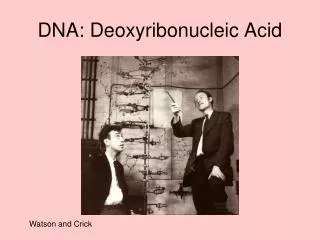
DNA: Deoxyribonucleic Acid Watson and Crick
DNA is a nucleic acid. The monomer is a nucleotide. Nitrogen bases make nucleotides different (A,T,G,C) Nucleotide is made of a sugar, phosphate and a nitrogen base
Complimentary base pairing means: A=T (2) G=C (3) Hydrogen bonds Chargaff’s rules: #A = #T #G = #C i.e. 30.9% A 29.4% T 19.8% C 19.9% G If given A = 30%, can you calculate C? --