The J.A.D. Bridge
100 likes | 215 Vues
On June 10, 2011, the J.A.D. Bridge Builders presented their innovative balsa wood bridge project to the UTA Summer Engineering Access Class. The objective was to create a scalable model bridge that spans a gorge, meeting strict dimensional requirements while supporting static and dynamic forces. Utilizing principles of civil engineering, including truss design and equilibrium concepts, the team successfully constructed a prototype that not only met but exceeded weight-bearing predictions. This project showcases the importance of collaboration and creativity in engineering challenges.


The J.A.D. Bridge
E N D
Presentation Transcript
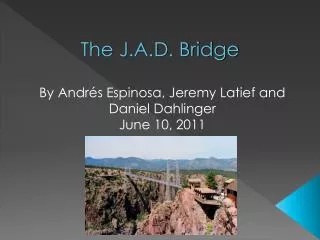
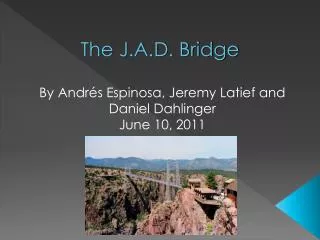
The J.A.D. Bridge By Andrés Espinosa, Jeremy Latief and Daniel Dahlinger June 10, 2011
Civil Engineering Bridge • J.A.D. Bridge Builders and Co. • The J.A.D. bridge • Andrés Espinosa, Daniel Dahlinger and Jeremy Latief • Presenting to the UTA Summer Engineering Access Class • June 10, 2011
Outline • Objectives • Introduction • Problem • Analysis • Results • Conclusion
Objectives • To make a bridge out of balsa wood. • The bridge must meet the requirements and restrictions of: • Length – min 10” , max 12” • Width – min 2”, max 3” • Height – min 2”, max 4” • The bridge must be able to sustain 15 pounds of static force and 15 pounds of dynamic force.
Introduction • What is a Civil Engineer? A civil engineer creates structures that are beneficial to the community. • A bridge is a structure built to span physical obstacles such as a body of water, valley, or road for the purpose of providing passage over the obstacle. • Truss bridges use triangle shapes because of their strength.
The Problem • It is 1910 and there is a gorge that needs to be crossed. This gorge spans 800ft and the minimum and maximum lengths for the bridge are 1000ft-1200ft. The minimum and maximum width of the bridge is 200ft and 400ft. The minimum and maximum height of the bridge is 200ft and 400ft. • The scale from prototype to actual bridge is 1 in. to 100ft. • To build the prototype, we have been given exactly 15 two ft. long balsa wood sticks and one bottle of tacky glue. • The prototype must support 15lbs. of static and dynamic force.
Analysis • We will build a Trapezoidal Bridge out of X- shapes and triangles. • Some equations we will use are the Pythagorean Theorem, Stress, statics and Equilibrium Concepts. • We will not be able to use any technology besides the materials and equipment provided.
The results • Our Company has successfully built a prototype bridge that we predict will support twenty pounds of static force and at least fifteen of dynamic force. Our work has developed a prototype bridge that will be constructed across the gorge.
Conclusion • The bridge will be successful in holding the desired weight and some more. Due to our successful results, this bridge design will be used for future bridge development.
THANK YOU!! • Thank you for listening to our presentation, also thank you to all the mentors that have helped us successfully complete this project! We couldn’t have done this much without you!!!