Sensation and Perception
This overview explores the complex interplay between sensation and perception, highlighting key theories such as the Recognition Threshold Theory, Absolute Threshold, and Difference Threshold. Delve into concepts like bottom-up and top-down processing, psychophysics, and signal detection theory, which examine how we detect and interpret stimuli. Discover the nuances of subliminal sensations, sensory adaptation, deprivation, overload, and interaction that shape our experiences and perceptions. Gain insights into how our psychological and physical responses to stimuli contribute to our understanding of the world around us.

Sensation and Perception
E N D
Presentation Transcript
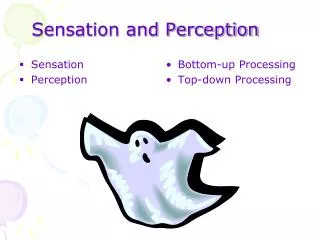
Sensation and Perception • Sensation • Perception • Bottom-up Processing • Top-down Processing
Sensation • Psychophysics • study of the relationship between the physical characteristics of stimuli and our psychological experience of them • What intensity does a stimulus have to be to detect. • How sensitive are we to changing stimuli.
Theories of Sensation • Recognition Threshold Theory • the stimulus must reach a certain level before it is recognized and reacted to
Theories of Sensation • Recognition Threshold Theory • Absolute Threshold • minimum stimulation needed to detect a particular stimulus 50% of the time
Theories of Sensation • Difference Threshold • Also called “just noticeable difference” (JND) • Weber’s (vay-bers) Law • to be perceived as different, two stimuli must differ by a constant proportion (percentage) rather than a constant amount • light intensity- 8% • weight- 2% • tone frequency- 0.3%
Subliminal Sensation & Perception • The perception of below threshold stimulus without awareness. • Evidence does not demonstrate that subliminal persuasion is possible. • “Much of our information processing occurs automatically, out of sight, off the radar screen of our conscious minds”
Theories of Sensation • Signal Detection Theory • assumes there are no thresholds • holds that response detection involves two things • Sensory process • Decision process • Involves • selective attention • response bias
Sensation • Sensory Adaptation • Sensory Deprivation • Sensory Overload
Sensation • Sensory Interaction • Smell + Tecture + Taste = Flavor