Enhancing Learning Through Goal Setting and Metacognition Strategies
Setting learning goals significantly boosts student performance, as demonstrated by Azevedo and Cromley (2004). This process involves metacognitive strategies, such as reflecting on key activities—like the ping pong relay—to enhance understanding. Students can simplify complex tasks by articulating hypotheses and sequential steps for problem-solving. Utilizing data analysis, including mean calculations and graphing, strengthens comprehension of concepts. This method encourages self-reflection and the ability to identify improvement opportunities, leading to better learning outcomes, as noted by Henderson and Dweck (1990).

Enhancing Learning Through Goal Setting and Metacognition Strategies
E N D
Presentation Transcript
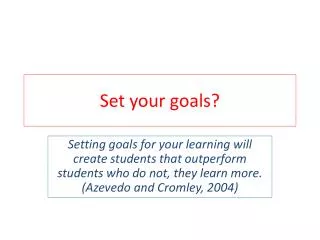
Set your goals? Setting goals for your learning will create students that outperform students who do not, they learn more. (Azevedo and Cromley, 2004)
Using metacognition is simple • think about the key points of the ping pong relay activity and take notes. • Write the three most important ideas of the activity on an index card. • hand the card in • Check
ping pong relay • "Now that you have completed the ping pong relay how quickly and easily can you create a hypothesis as a if, then and because statement. • "Now that you have completed this homework, how quickly and easily can you identify the steps you use to solve a problem?
Check pg. 52-53 • Data table complete • Title, labels in grid pattern • Mean time • Graph complete • 4 parts, key, title, y and x axis labeled correctly • Bar graph in color that connects to key • Analysis of results • Uses Mathematical concepts, mean, to explain patterns • Identifies possible error in investigation • Conclusion • 3 parts, restates and answers question, • states if hypothesis is supported or unsupported and why • Reflection how project can be extended into a related investigation
Self reflection • “Now that you have completed the ping pong relay how quickly and easily can you create a hypothesis as a if, then and because statement.” • "Now that you have completed this homework, how quickly and easily can you identify the steps you use to solve a problem?”
Check key points 1. The water and ball do not move until the runner picks up the bowl 2. The runners movements cause the water and ball to move around in the bowl often causing the water to spill 3. The biggest sloshes occur when the runner changes speed or direction going around the markers 4. Acceleration occurs if its speed, its direction, or both change 5. Velocity, speed in a direction
Using metacognition • Students who believe that the ability to learn can improve over time earn higher grades, (Henderson and Dweck, 1990).