Manual Route Configuration in Networking: Advantages and Disadvantages
Manual route configuration allows administrators to add routes to each router's routing table directly. This method has key advantages, including no overhead on CPU usage and no bandwidth consumption between routers, enhancing security by controlling network access. However, it requires comprehensive understanding of the network's structure. As networks grow, the need for manual updates on all routers can become overwhelming, making it impractical for large environments. Effective route management becomes crucial for maintaining a robust and efficient intranet.

Manual Route Configuration in Networking: Advantages and Disadvantages
E N D
Presentation Transcript
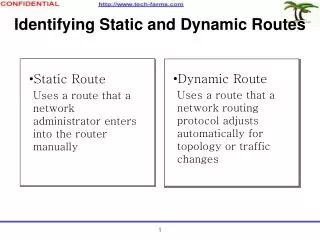
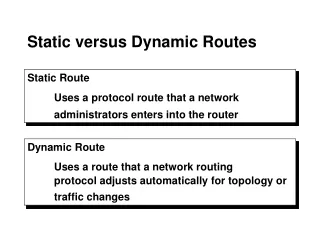
Static Routes Static routing occurs when you manually add routes in each router's routing table.
Advantages • There is no overhead on the router CPU. • There is no bandwidth usage between routers. • It adds security because the administrator can choose to allow routing access to certain networks only.
Disadvantages • The administrator must really understand the internetwork and how each router is connected in order to configure routes correctly. • If a network is added to the internetwork, the administrator has to add a route to it on all routers—manually. • It's not possible in large networks because maintaining it would be a full-time job in itself.