SlideServe
Menu
Préférences
© SlideServe · v2026

Experience & Learning for the Postmodern Caveman

ray-dorsey avatar
13 diapositives · 385 Views · Nov 29, 2014

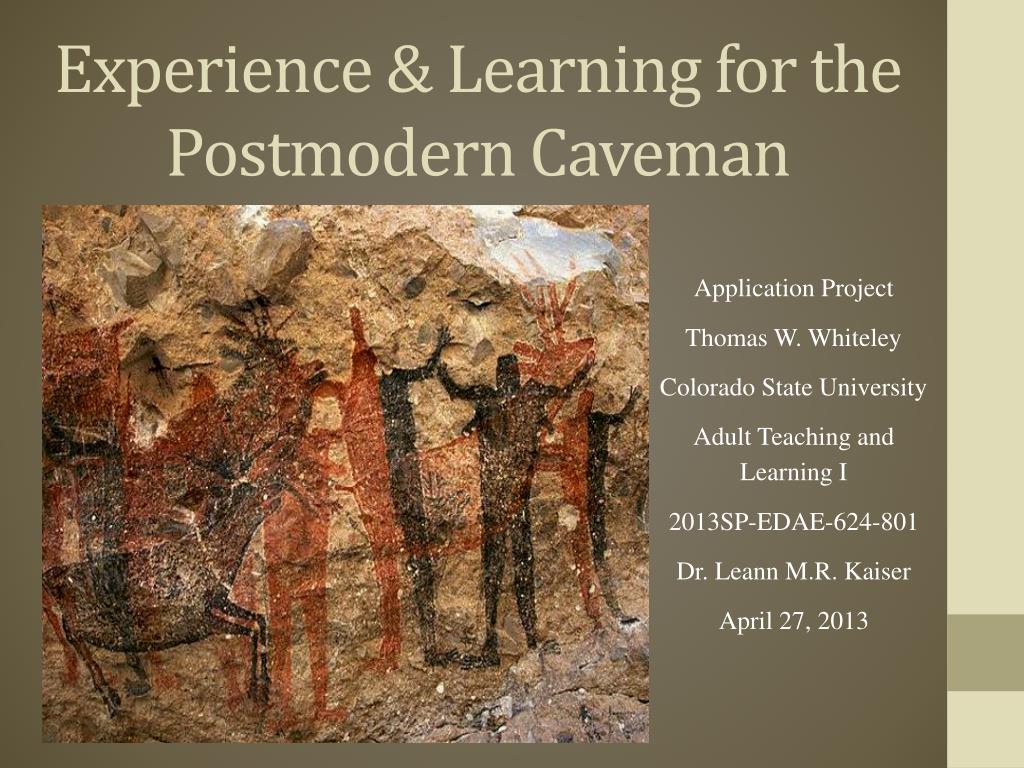
Experience & Learning for the Postmodern Caveman. Application Project Thomas W. Whiteley Colorado State University Adult Teaching and Learning I 2013SP-EDAE-624-801 Dr. Leann M.R. Kaiser April 27, 2013.
Experience & Learning for the Postmodern Caveman - slide 1
01 / 13Experience & Learning for the Postmodern Caveman
1 / 17

Télécharger la présentation

Experience & Learning for the Postmodern Caveman
Une image / un lien ci-dessous est fourni (tel quel) pour télécharger la présentation

Politique de téléchargement : le contenu du site vous est fourni TEL QUEL pour votre information et votre usage personnel ; il ne peut être vendu, concédé sous licence ni partagé sur d’autres sites sans l’accord de son auteur.Le contenu vous est fourni TEL QUEL, pour votre information et votre usage personnel uniquement. Téléchargez la présentation en cliquant sur ce lien. Lors du téléchargement, si vous ne parvenez pas à télécharger une présentation, l’éditeur a peut-être supprimé le fichier de son serveur.Pendant le téléchargement, si vous ne parvenez pas à obtenir une présentation, le fichier a peut-être été supprimé par l’éditeur.

F I N

Plus de contenu associé

Transcription de la présentation
  1. Experience & Learning for the Postmodern Caveman Application Project Thomas W. Whiteley Colorado State University Adult Teaching and Learning I 2013SP-EDAE-624-801 Dr. Leann M.R. Kaiser April 27, 2013

  2. As the caveman recorded his history though a visual presentation upon the walls of caves, I have recorded the history of my newly required knowledge in experience and learning. These 21st century hieroglyphics are to be used as a modern tool in which I can apply learner-centered opportunities that may present itself to me. They shall act as my guild, and reminder of learning through experience.

  3. How the Postmodern Man learns(Tools) • 1. Reflecting on concrete experience • (Constructivist theory) • 2. Participating in a community of Practice • (situative theory) • 3. Understanding of desires and fears • (psychoanalytic theory) • 4. Resisting dominant social norms • (critical cultural theories) • 5. Exploring ecological relationships • (complexity theories) • (Fenwick, 2003)

  4. Reflecting on Concrete Experience(Constructivist Theory) Click Here Constructivism Concrete Experience; engaging oneself in a new experience Reflective Observation; skills in recognizing experiences from different perspectives Abstract Conceptualization; taking the experiences and analyzing it in which to create new ideas and concepts Active Experimentation; retaining decision-making and problem-solving abilities for actively engaging in experimentation on newly formed concepts (Kolb, 1984)

  5. Participating in a community of Practice(situative theory) Community of Practice Click Here A group of people who share a passion for something they know how to do We should cultivate and nurture the growth Fundamental Purpose Create, Expand and Exchange of knowledge within the Individual (Wenger, McDermott, & Snyder, 2002)

  6. Understanding of desires and fears (psychoanalytic theory) • The psychoanalytic perspective sees our unconscious and interfering with our conscious experiences • Work through psychic conflicts to learn • (Fenwick, 2003) Power of the Unconscious Mind Click Here

  7. Resisting dominant social norms (critical cultural theories) • Transforming existing social orders by questioning and resisting norms • Where is postmodernism • (Fenwick, 2003) Whose lens is it anyways? Click Here

  8. Exploring ecological relationships (complexity theories) • Leaning is the sum of it parts • “Consciousness, identity, action and interaction, objects and structural dynamics of complex systems” (p. 37) • Binding the experiences in a complex system • (Fenwick, 2003) Simplifying the Complexity Click Here

  9. The gathering of Information is complicatednot complex

  10. Experience and Education: A Brief Summary Click Here John Dewey

  11. Good Will Hunting (Rated R for Language) http://www.youtube.com/watch?v=qM-gZintWDc

  12. Summary

  13. How the Postmodern Man learns • Reference • Fenwick, T. J. (2003). Leaning through experience: Troubling orthodoxies and intersecting questions. Malabar, FL: Krieger • Kolb, D. A. (1984). Experiential learning: Experience as the source of learning and development. Englewood Cliffs, NJ: Prentice Hall • Wenger, E., McDermott, R., & Snyder, W. (2002). Cultivating communities of practice: A guide to managing knowledge – seven principles for cultivating communities of practice. Retrieved from http://hbswk.hbs.edu/archive/2855.html