Exploring Meiosis: The Key to Genetic Diversity
240 likes | 375 Vues
Learn about the importance of reproduction in organisms, exploring both asexual and sexual reproduction. Delve into the intricate process of meiosis, the cell division that aids in genetic diversity. Understand the stages of meiosis and its significance in producing haploid gametes. Discover the fascinating processes of spermatogenesis and oogenesis in humans.


Exploring Meiosis: The Key to Genetic Diversity
E N D
Presentation Transcript
MEIOSIS Chapter 10
A. Types of Reproduction 1. Asexual Reproduction • involves only 1 parent • offspring are genetically identical to the parent (clones) • advantageous when organism is well-adapted to a stable environment Ex. binary fission, parthenogenesis
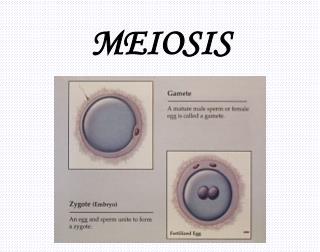
2. Sexual Reproduction • involves 2 parents • parents produce haploid(1n) gametes which fuse to form a diploid(2n) zygote (first cell of offspring). • offspring are genetically diverse • advantageous in a changing environment
Variations: • Alternation of generations in plants • Conjugation in bacteria Haploid gametes are produced by a type of cell division called meiosis.
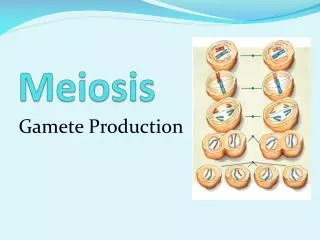
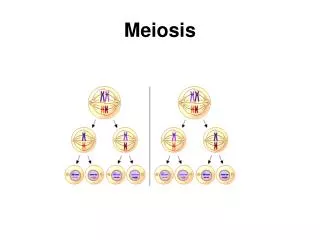
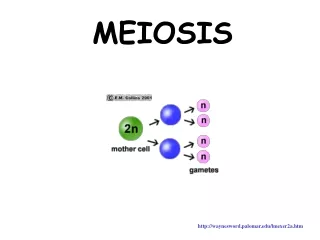
B. Meiosis Type of cell division that halves the number of chromosomes. • involves 2 nuclear divisions (meiosis I & meiosis II) • 1 diploid (2n) cell 4 haploid (1n) cells • occurs in germ cells In humans, where would germ cells be located?
Germ cell replicates its chromosomes in S phase of the cell cycle. 1. Meiosis I (reduction division) • Prophase I • replicated chromosomes condense • spindle apparatus forms & fibers attach to chromosomes • nucleolus disappears • nuclear membrane breaks down • synapsis & crossing over occurs
Synapsis - homologous chromosomes (homologs)pair up. Homologs - chromosomes that carry genes for the same traits in the same sequence. A diploid human cell has 23 homologous pairs.
Crossing over - non sister chromatids of homologs exchange chromosomal material which leads to new genetic combinations. Chiasma - visible point of cross over between homologs.
Metaphase I • paired homologous chromosomes line up along equator of spindle
Anaphase I • homologous chromosomes separate & move to opposite poles
Telophase I • spindle apparatus breaks down • chromosomes decondense • nuclear membranes partially reform around two nuclei Cytokinesis usually occurs between meiosis I & II
2. Meiosis II (equational division) • Prophase II • chromosomes condense • spindle apparatus forms & fibers attach to chromosomes • nuclear membrane breaks down • Metaphase II • chromosomes line up single-file along equator of spindle
Anaphase II • centromeres part; sister chromatids (now called chromosomes) separate & move toward opposite poles • Telophase II • spindle apparatus breaks down • chromosomes de-condense • nuclear membranes reform • nucleoli reappear Cytokinesis divides two cells into four nonidentical cells.
Meiosis II Four non-identical haploid cells Prophase II Metaphase II Anaphase II Telophase II
C. Gametogenesis in Humans 1. Spermatogenesis (meiosis in the male)
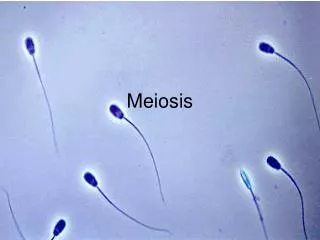
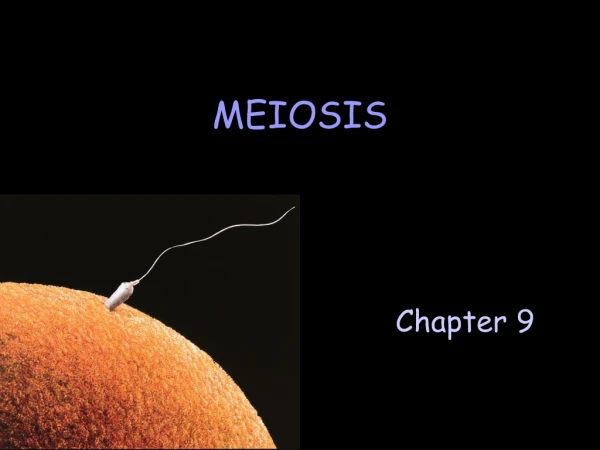
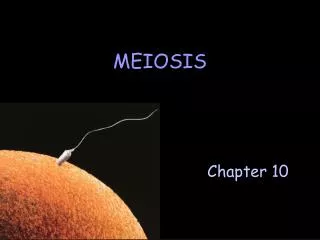
Structure of human sperm: • Head • nucleus - 23 chromosomes • acrosome - contains enzymes that help sperm penetrate egg • Midpiece • mitochondria • Tail