Download
1 / 13
130 likes | 248 Vues
This study examines the historical distribution and altitudinal shifts of vegetation in the Montseny Mountains, focusing on species such as Calluna vulgaris and their interactions with climatic and ecological changes from 1703 to 2001. It highlights the progressive substitution of beech forests by holm oaks at mid-altitudes, the effects of droughts on forest composition, and the impact of global change on local biodiversity. Key findings demonstrate significant shifts in biomes and species distributions linked to climate variability, providing insights for conservation and management efforts.

E N D
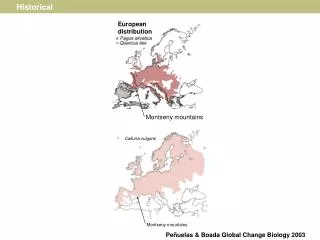
Historical European distribution Montseny mountains Calluna vulgaris Montseny mountains Peñuelas & Boada Global Change Biology 2003
Historical (1703 m) (1703 m) Subalpine species N Desplazamientos altitudinales de los biomas Peñuelas & Boada Global Change Biology 2003
Ascenso altitudinal del encinar Historical 1969 2001 E 1706 m MS 1400 m 1200 m Quercus ilex young forest Erica scoparia heathland Calluna vulgaris heathland Pteridium aquilinum fernland Grassland and Cytisus scoparius Meteorological station MS Peñuelas & Boada Global Change Biology 2003
Historical Desplazamiento altitudinal (70 m) hasta las cimas N 1703 m B H 1945 2001 B Beech, H Heathland Peñuelas & Boada Global Change Biology 2003
Historical Confinamiento del hayedo en las cimas de las montañas N 1224 m B HO 2001 B Beech, HO Holm oak Peñuelas & Boada Global Change Biology 2003
Historical MONTSENY MOUNTAINS Beech forest distribution Matagalls Navall Les Agudes Turó de l’home Sea breezes Peñuelas & Boada Global Change Biology 2003
Historical Progresiva substitución del hayedo por el encinar en las altitudes medias (800-1200 m) 1100 m N C HO B I P Continental (C), peninsular (P) and isolated (I) beech stands B Beech, HO Holm oak Peñuelas & Boada Global Change Biology 2003
Historical 3 Beech defoliation status 2 * 1 8 * 6 Beech recruitment (saplings per plot) 4 2 12 9 Holm oak recruitment (saplings per plot) 6 3 Isolated stands • Continental stands * Peñuelas & Boada Global Change Biology 2003
Efectos de la sequía del 1994 Peñuelas, Lloret, Montoya Forest Science 2001
Cambio climático Peñuelas, Filella, Lloret, Piñol, Siscart 2000 Biologia Plantarum
Cambio climático 2 2 N-facing Breccia N-facing Schists S-facing Conglomerates 2 1 2 0 1 9 D13C (‰) 1 8 1 7 s e v e r e d r o u g h t 1 6 1 5 - 3 - 4 d15N (‰) Aunque los dos años siguientes a la sequía fueron húmedos, D13C continuó bajando en las zonas donde los árboles fueron más afectados: efecto memoria - 5 - 6 - 7 Cuanto mayor fue el efecto de la sequía mayores fueron las pérdidas de N 1 9 9 3 1 9 9 4 1 9 9 5 1 9 9 6 1 9 9 7 Consecuencias fisiológicas Quercus ilex Peñuelas, Filella, Lloret, Piñol, Siscart 2000 Biologia Plantarum
Cambio climático Dos años despues de la sequía P. latifolia estaba menos afectada: utilizó más el agua y perdió menos nitrógeno Quercus ilex vs. Phillyrea latifolia Peñuelas, Filella, Lloret, Piñol, Siscart 2000 Biologia Plantarum