Understanding the Immune System: Its Role in Protecting Against Pathogens
The immune system is a vital defense mechanism that protects our bodies from various pathogens, including viruses, bacteria, and toxins. It identifies and neutralizes harmful invaders such as carcinogens, germs, fungi, and parasites. Diseases can spread through direct and indirect contact, contaminated food and water, and animal bites. The body employs multiple defense strategies, including physical barriers like skin and mucous membranes. This overview highlights the types of pathogens and the mechanisms the body uses to maintain health and prevent illness.

Understanding the Immune System: Its Role in Protecting Against Pathogens
E N D
Presentation Transcript
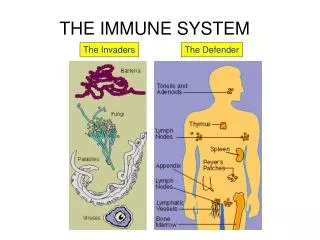
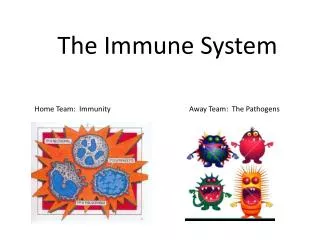
The Job of the Immune System The immune system protects our bodies from a variety of pathogens (organisms that cause diseases).
Types of Pathogens*Virus-ultramicroscopic infectious agent that replicates itself only within cells of living hosts.
*Pollution-undesirable state of the natural environment being contaminated with harmful substances as a consequence of human activities .
*Germs- microbe: a minute life form (especially a disease-causing bacterium)
is a poisonous substance produced by living cells or organisms. *Toxins-
*Fungi- including yeast, molds, smuts, mushrooms, and toadstools; distinct from the green plants.
*Bacteria- single-celled or noncellular spherical or spiral or rod-shaped organisms lacking chlorophyll.
*Parasites- an animal or plant that lives in or on a host (another animal or plant); it obtains nourishment from the host without benefiting or killing the host.
How Diseases are Spread *Person to person -Direct physical contact (kissing, hugging, shaking hands). -Indirect contact such as sneezing and coughing. *Contaminated Objects -Water and food -Using towels and silverware -Contaminated nail *Animal Bites -Animals biting a person can transfer the pathogen. *The environment -Naturally occurring in soil and water.
How does the body defend itself? • Barriers -Breathing passages • Skin • Mouth and stomach