Mastering Formal Commands in Spanish: A Comprehensive Guide
In this presentation, you will learn how to construct formal commands in Spanish. While commands in English are straightforward, Spanish requires an understanding of different forms of "you." We focus on the formal commands using "Ud." and "Uds." You'll discover examples that show how to create commands from verbs, including irregular forms. Learn the formation of affirmative and negative commands, including reflexive verbs. This knowledge is essential for effective communication in Spanish. Engage with examples and grasp the nuances of command structure.

Mastering Formal Commands in Spanish: A Comprehensive Guide
E N D
Presentation Transcript
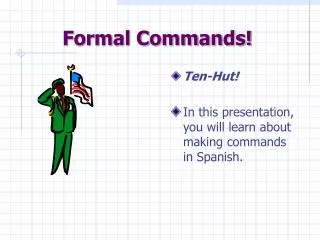
Formal Commands! • Ten-Hut! • In this presentation, you will learn about making commands in Spanish.
Commands in English… … are pretty easy. You just use a base verb form (without a subject, since it’s always “you”) to tell people what they should do: • Stand up! • Sit down! • Do your homework! • Take out the garbage! • Be quiet!
Commands in English… … and what they shouldn’t do: • Don’t write in your books! • Don’t speak English in Spanish class! • Don’t be silly!
Commands in Spanish… … are little more complicated because we have so many ways of saying “you”: • Tú: informal, singular • Vosotros: informal, plural • Ud.: formal, singular • Uds.: formal, plural • However, we will concentrate on the formal commands only.
Let’s look at a few examples! • Hable despacio, por favor. • ¡Repita, por favor.! • Hagan el ejercicio B. • No hagan el ejercicio A. • ¡No se levante Ud.! • ¡No corran en la clase!
Hable despacio, por favor. • The speaker is talking to one person. • Can you figure out how we got the form “hable”? • Take the “yo” form of the present: HABLO • Drop the –o: HABL- • “Hablar” is an –AR verb, so add –E to form the command:HABLE
Repita, por favor. • The speaker is talking to one person. • Can you figure out how we got the form “repita”? • Take the “yo” form of the present: REPITO • Drop the –o: REPIT- • “Repetir” is an –IR verb, so add –A to form the command:REPITA
Opposite vowels • Think of the verb adding the “opposite vowel”: • AR verbs add an –E. • ER & IR verbs add an –A.
Let’s try a couple! • Comer: ¡______ Ud.! • ¡Coma Ud.! • Escribir: ¡_____ Ud.! • ¡Escriba Ud.! • Tomar: ¡_____ Ud.! • ¡Tome Ud.! • Entregar: ¡_____ la tarea! • ¡Entregue la tarea! • Note the spelling change because of the final –g sound.
Uds… • Entreguen Uds. la tarea. • Right! Just add an –N to the command form when you are talking to more than one person.
Let’s try a couple more! • Comer: ¡______ Uds.! • ¡Coman Uds.! • Escribir: ¡_____ Uds.! • ¡Escriban Uds.! • Tomar: ¡_____ Uds.! • ¡Tomen Uds.! • Comenzar: ¡_____ el examen! • ¡Comiencen el examen! • Note the spelling change because of the final –z.
¡Levántese! • What about reflexive verbs? • ¡Levántese! / ¡Siéntese! • In affirmative commands, all objects are attached to the end of the verb. • Levante + se • Levanten + se
¡No! • How do we make negative commands in Spanish? • ¡No fume! • ¡No tome café! • ¡No coma tanto! • Right – simply put the word NO in front of the command form.
¡No se levante! • What about reflexive verbs? • ¡No se levante! ¡No se siente! • In negative commands, all objects precede the verb. • No se levante. • No se levanten. • No se siente. • No se sienten.
Some irregulars • What would a lesson be without a few irregulars to make it interesting?? Can you guess where these forms come from? • ¡Sea Bueno! • ¡Esté tranquilo! • Sepa Ud. la respuesta. • Den Uds. Un ejemplo, por favor. • ¡Vaya a la clase.
Sea, esté, dé, sepa, vaya • These five verbs are very irregular for a good reason: • Ser > yo soy sea, sean • Estar > yo estoy esté, estén • Dar > yo doy dé, den • Saber > yo sé sepa, sepan • Ir > yo voy vaya, vayan • The yo form does not end in an –o, so there is no –o to drop when forming the command form.