Understanding Classical Greece: City-States, Governance, and Key Concepts
This overview explores essential aspects of Classical Greece, focusing on city-states, governance structures, and pivotal battles. Key terms include "city-state," reflecting independent communities; "trireme," the powerful ships of the era; and various forms of government like monarchy, oligarchy, democracy, and aristocracy. The significance of battles such as Marathon is highlighted, showcasing the Athenians' victory over Persian forces and the origins of the modern marathon race. Additionally, the role of philosophers in questioning the universe and society is examined, illustrating their lasting impact on Western thought.

Understanding Classical Greece: City-States, Governance, and Key Concepts
E N D
Presentation Transcript
Classical Greece Vocab
City-state: A city that functions much like an independent country • Trireme: strong wooden ships built with battering ram in front
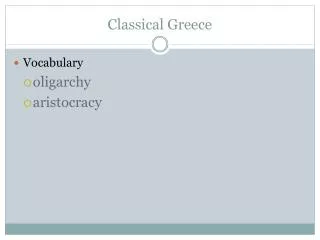
Monarchy: a government ruled by a king or queen • Oligarchy: a government in which power is in the hands of a few people – especially one in which rule is based on wealth • Democracy: a government controlled by its citizens • Aristocracy: a government in which power is in the hands of a hereditary ruling class or nobility
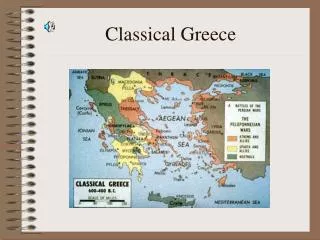
Direct Democracy: • Citizens are directly involved in the government. • Indirect Democracy: • representatives make the laws on the behalf of the people. • Marathon: marshy plain where the Athenians successfully defeated an invading Persian force during the Persian Wars. Also origin of Marathon run due to messenger Pheidippides.
Philosopher: a thinker who uses logic and reason to investigate the nature of the universe, human society, and morality; also known as lover of wisdom