Understanding the Divide-and-Conquer Paradigm: Concepts, Algorithms, and Analysis
200 likes | 334 Vues
This comprehensive overview of the Divide-and-Conquer paradigm explores essential concepts, algorithms, and analytical techniques. Key topics include the fundamental steps of Divide-and-Conquer and detailed explanations of the Merge Sort algorithm, recurrence equations, iterative substitution, recursion trees, and the Master Theorem. Various examples illustrate these techniques, while insights into improving integer multiplication highlight practical applications. Ideal for students and professionals, this guide enhances your understanding of algorithm design and analysis.


Understanding the Divide-and-Conquer Paradigm: Concepts, Algorithms, and Analysis
E N D
Presentation Transcript
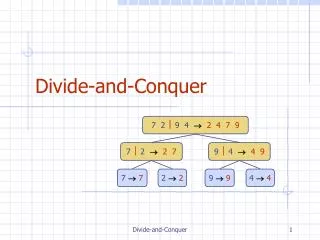
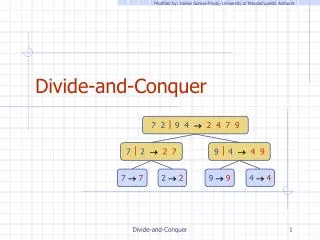
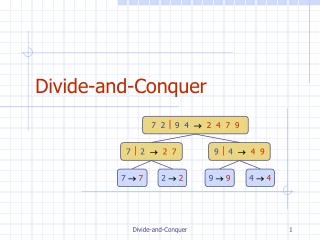
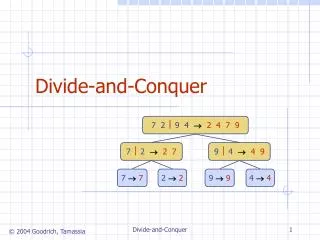
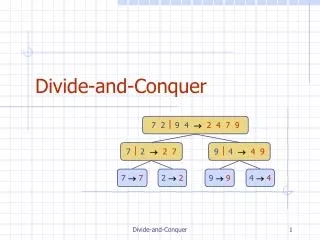
7 2 9 4 2 4 7 9 7 2 2 7 9 4 4 9 7 7 2 2 9 9 4 4 Divide-and-Conquer Divide-and-Conquer
Outline and Reading • Divide-and-conquer paradigm (§5.2) • Review Merge-sort (§4.1.1) • Recurrence Equations (§5.2.1) • Iterative substitution • Recursion trees • Guess-and-test • The master method • Integer Multiplication (§5.2.2) Divide-and-Conquer
Divide-and conquer is a general algorithm design paradigm: Divide: divide the input data S in two or more disjoint subsets S1, S2, … Recur: solve the subproblems recursively Conquer: combine the solutions for S1,S2, …, into a solution for S The base case for the recursion are subproblems of constant size Analysis can be done using recurrence equations Divide-and-Conquer Divide-and-Conquer
Merge-sort on an input sequence S with n elements consists of three steps: Divide: partition S into two sequences S1and S2 of about n/2 elements each Recur: recursively sort S1and S2 Conquer: merge S1and S2 into a unique sorted sequence Merge-Sort Review AlgorithmmergeSort(S, C) Inputsequence S with n elements, comparator C Outputsequence S sorted • according to C ifS.size() > 1 (S1, S2)partition(S, n/2) mergeSort(S1, C) mergeSort(S2, C) Smerge(S1, S2) Divide-and-Conquer
Recurrence Equation Analysis • The conquer step of merge-sort consists of merging two sorted sequences, each with n/2 elements and implemented by means of a doubly linked list, takes at most bn steps, for some constant b. • Likewise, the basis case (n< 2) will take at b most steps. • Therefore, if we let T(n) denote the running time of merge-sort: • We can therefore analyze the running time of merge-sort by finding a closed form solution to the above equation. • That is, a solution that has T(n) only on the left-hand side. Divide-and-Conquer
Iterative Substitution • In the iterative substitution, or “plug-and-chug,” technique, we iteratively apply the recurrence equation to itself and see if we can find a pattern: • Note that base, T(n)=b, case occurs when 2i=n. That is, i = log n. • So, • Thus, T(n) is O(n log n). Divide-and-Conquer
The Recursion Tree • Draw the recursion tree for the recurrence relation and look for a pattern: Total time = bn + bn log n (last level plus all previous levels) Divide-and-Conquer
Guess-and-Test Method • In the guess-and-test method, we guess a closed form solution and then try to prove it is true by induction: • Guess: T(n) < cn log n. • Wrong: we cannot make this last line be less than cn log n Divide-and-Conquer
Guess-and-Test Method, Part 2 • Recall the recurrence equation: • Guess #2: T(n) < cn log2 n. • if c > b. • So, T(n) is O(n log2 n). • In general, to use this method, you need to have a good guess and you need to be good at induction proofs. Divide-and-Conquer
Master Method • Many divide-and-conquer recurrence equations have the form: • The Master Theorem: Divide-and-Conquer
Master Method, Example 1 • The form: • The Master Theorem: • Example: Solution: logba=2, so case 1 says T(n) is O(n2). Divide-and-Conquer
Master Method, Example 2 • The form: • The Master Theorem: • Example: Solution: logba=1, so case 2 says T(n) is O(n log2 n). Divide-and-Conquer
Master Method, Example 3 • The form: • The Master Theorem: • Example: Solution: logba=0, so case 3 says T(n) is O(n logn). Divide-and-Conquer
Master Method, Example 4 • The form: • The Master Theorem: • Example: Solution: logba=3, so case 1 says T(n) is O(n3). Divide-and-Conquer
Master Method, Example 5 • The form: • The Master Theorem: • Example: Solution: logba=2, so case 3 says T(n) is O(n3). Divide-and-Conquer
Master Method, Example 6 • The form: • The Master Theorem: • Example: (binary search) Solution: logba=0, so case 2 says T(n) is O(log n). Divide-and-Conquer
Master Method, Example 7 • The form: • The Master Theorem: • Example: (heap construction) Solution: logba=1, so case 1 says T(n) is O(n). Divide-and-Conquer
Iterative “Proof” of the Master Theorem • Using iterative substitution, let us see if we can find a pattern: • We then distinguish the three cases as • The first term is dominant • Each part of the summation is equally dominant • The summation is a geometric series Divide-and-Conquer
Integer Multiplication • Algorithm: Multiply two n-bit integers I and J. • Divide step: Split I and J into high-order and low-order bits • We can then define I*J by multiplying the parts and adding: • So, T(n) = 4T(n/2) + n, which implies T(n) is O(n2). • But that is no better than the algorithm we learned in grade school. Divide-and-Conquer
An Improved Integer Multiplication Algorithm • Algorithm: Multiply two n-bit integers I and J. • Divide step: Split I and J into high-order and low-order bits • Observe that there is a different way to multiply parts: • So, T(n) = 3T(n/2) + n, which implies T(n) is O(nlog23), by the Master Theorem. • Thus, T(n) is O(n1.585). Divide-and-Conquer