
Ecosystems
E N D
Presentation Transcript
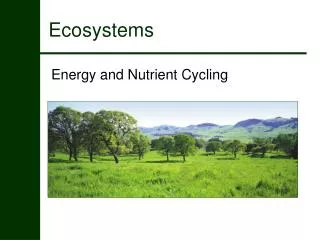
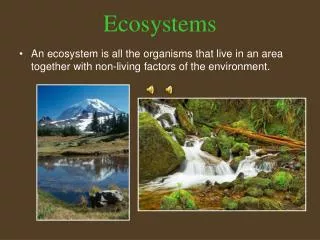
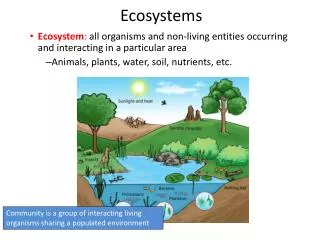
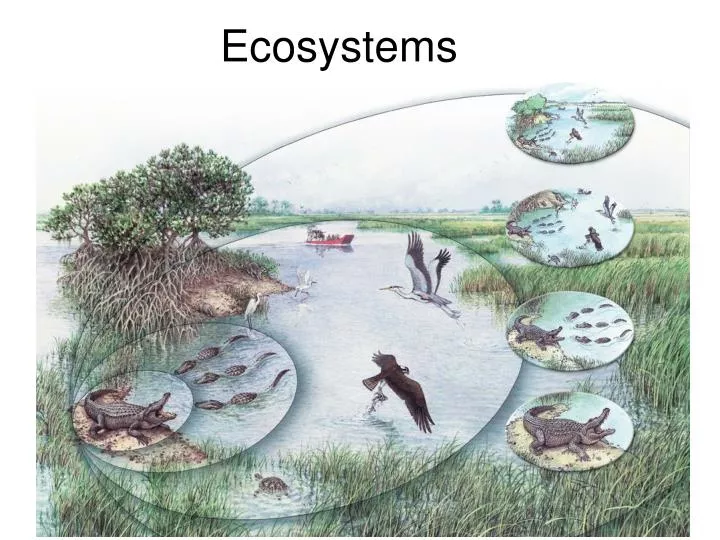
Ecosystem Ecosystem Community Community Population Population Organism Organism • An ecosystem includes all of the organisms as well as the climate, soil, water, rocks and other nonliving things in a given area.
Community Community Population Population Organism Organism • A community is a group of different species that live together in one area.
plants An ecosystem includes both biotic and abiotic factors. • Biotic factors are living things. • plants • animals • fungi • bacteria
sunlight moisture • moisture • temperature • wind • sunlight • soil • Abiotic factors are nonliving things.
Use the following terms for the examples on the next several pages • habitat • community • ecosystem • abiotic factors • biotic factors • biodiversity • succession
An anthill • habitat
A forest • ecosystem
548 different species living in the forest • biodiversity
The damp soil of a forest within which a mushroom grows. • habitat
The pH of a lake • Abiotic factor
First grasses, then shrubs, then small trees, finally large trees grow in an area • Succession
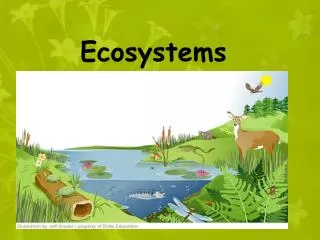
Frogs, fish, turtles, lilypads, and dragonflies in a pond • Community or biotic factors
A prairie, with its living and nonliving components • An Ecosystem
All the organisms in acompost pile Community or biotic factors
Give examples of: • community • black bears, Eastern rattlesnakes, bluebirds, trees, shrubs • abiotic factors • temperature, rainfall, humidity, smog level • habitat • bee hive, rabbit burrow, squirrel nest • producers • trees, grasses, algae in streams • consumers • deer, rabbits, squirrels, foxes, birds • decomposers • bacteria, worms
Making a food webhttp://www.classzone.com/cz/books/bio_07/resources/htmls/animated_biology/unit5/bio_ch13_0421_ab_foodweb.html
Only ___ % of the energy from one trophic level passes to the next.
A = precipitation B = precipitation C = transpiration (water released from plants) D = percolation or seepage E = runoff F = evaporation
A = carbon dioxide in air B = photosynthesis C = plants, algae D = respiration E = herbivore consuming grass F = carnivore consuming animal
G = respiration H = death I = bacteria J = decay releases CO2 K = fossil fuels produced L = refinery M = combustion/burning of fossil fuels N = burning releases CO2 O = fires release CO2
A = atmospheric nitrogen B = nitrogen converted to ammonia C = legume (peas, peanuts, beans, alfalfa) D = bacteria E = waste converted to ammonia
F = nitrates formed from ammonia G and H = bacteria I = plants use nitrates J = animals eat plants K = bacteria convert nitrates to nitrogen