Homonyms Week 1
130 likes | 255 Vues
Dive into the world of homonyms with this concise guide focusing on commonly confused words: "there," "their," "they're," "your," and "you're." Learn how to distinguish between these terms based on their meanings and usage in sentences. Gain practical tips and memory tricks to ensure you're using the right word in the right context. This resource is ideal for anyone looking to improve their writing and avoid common mistakes. Clear examples illustrate each homonym’s function, empowering you to communicate effectively.


Homonyms Week 1
E N D
Presentation Transcript
Coleman 2011 Homonyms Week 1
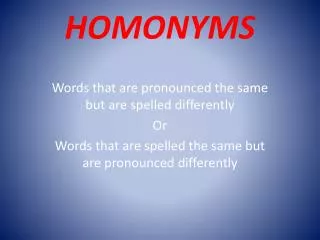
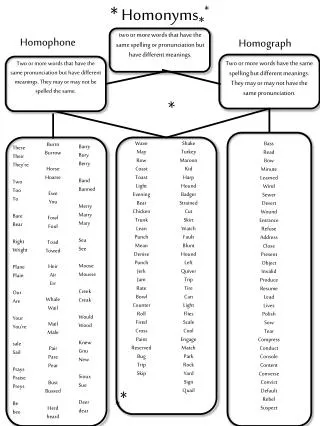
What is a homonym? • Words that are spelled the same but pronounced differently OR • Words that are pronounced the same but spelled differently
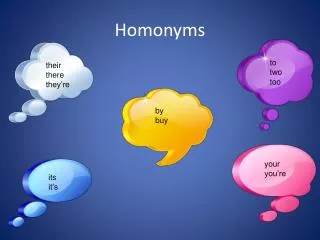
There, their—they’re not the same! Most people pronounce these the same way; therefore, it is difficult for some to judge in which situation to use which spelling. But each spelling means a very different thing, so it is important to learn the difference between them.
THERE • Use THERE when referring to a place: • The science textbooks are over there on the floor. • It must be tough to live there. • Use THERE with state-of-being verbs (am, is, are, was, were) to indicate the existence of something: • There are many foods that I enjoy. • There is a lot of homework tonight.
THEIR • Use THEIR to show possession—to indicate that a particular noun belongs to them. • Their car is in the shop. • Do you have their address? • My house is small, but their house is big.
THEY’RE • THEY’RE is a contraction that is short for they are. • They’re coming over for dinner tomorrow. • Does anyone know why they’re running late?
Your teacher is pleased when you’re using the correct spelling! • YOUR is the possessive form of you, referring to something a person owns or has. • YOU’RE is a contraction that is short for you are.
YOU’RE • There is a replacement test that will tell you for certain which word will fit. Read the sentence with "you are" in place of where the "your/you're" is intended. If it makes sense, then YOU’RE would be right. If not, then YOUR would fit. • You’re going to get me in trouble. (Can be replaced with “You are going to get me in trouble.”) • Are you going to eat you’re sandwich? (This is incorrect because it doesn’t make sense to say “Are you going to eat you are sandwich?”)
YOUR • In this case, you could test which is correct by replacing "your" with "my" in the sentence. If it fits, then use "your.“ • Your report card was very good! (Can be replaced with “My report card was very good!” and it still makes sense.) • Go to your room!
DESERT/DESSERT • DESERT • with the emphasis on the first syllable, “DE sert”, is a dry, arid piece of land • with the emphasis on the second syllable, “de SERT”, is a verb meaning to abandon • DESSERT • pronounced “de SERT” is a treat served at the end of a meal, usually something sweet
MEMORY TRICK • Only use DESSERT with 2 s’s when referring to that sweet treat at the end of a meal. Think of it this way—I would rather have 2 DESSERTS than 2 DESERTS!
ANT/AUNT • An ANT is an insect. • Your AUNT is the sister of one of your parents. MEMORY TIP: “U” are related to your AUNT, but not to any ANTS!